SPINE AI rebuilds neutrino collisions, now on eight detectors
Trillions of neutrinos pass through each person every second, and almost none of them leave a trace. Catching a handful in a detector is only the first step. The harder task comes afterwards: reconstructing what happened from a picture crowded with overlapping particle tracks, electromagnetic showers and background cosmic rays. SPINE, a machine-learning program developed at the SLAC National Accelerator Laboratory, is built for that task, and it now runs on eight detectors at about 25 institutions worldwide.
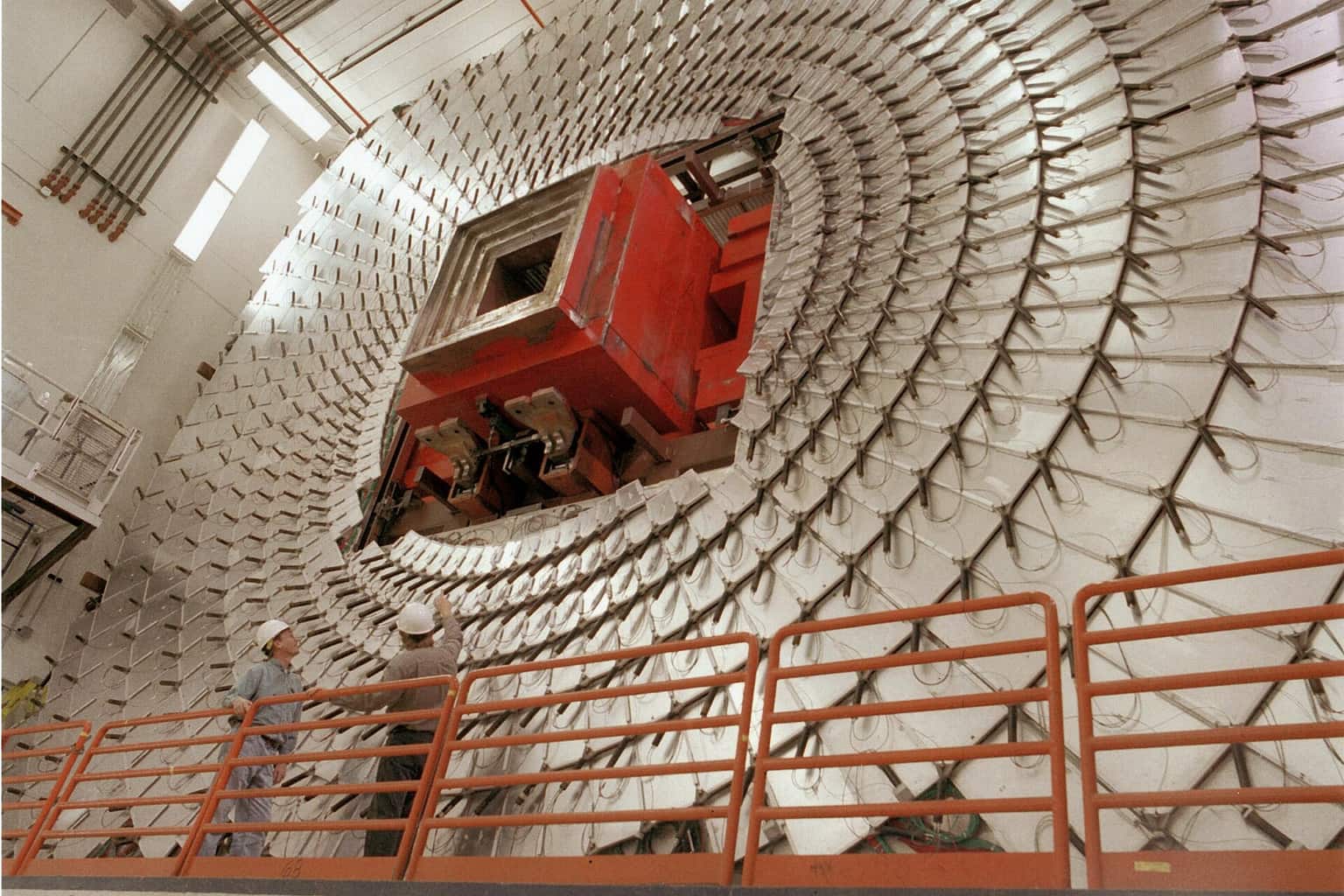
The raw data comes from liquid argon time-projection chambers. Those detectors hold hundreds to thousands of tons of ultrapure liquid argon, kept at around -300 F. When a neutrino strikes an argon atom, the collision can send several particles through the liquid. They leave trails of electrons that drift toward collection wires, which builds a three-dimensional picture of the event. The picture is so dense that a single image can contain many interactions at once, each mixed with cosmic-ray activity.
For years, researchers handled this with chains of specialized algorithms, each performing one narrow task before passing its result to the next. An error at any step could spread through the rest of the reconstruction. SPINE replaces that rigid chain with several machine-learning models that work in sequence. The first model spots basic features in the image, the next identifies individual particles, and the last assembles the complete interaction. Because each level is built on the one below, the program reconstructs the particles behind each result, rather than delivering an answer with no visible trail. Kazuhiro Terao began applying computer-vision techniques to neutrino images in 2015 and 2016, and Francois Drielsma, the program's lead developer, later turned that work into SPINE.
The first neutrino physics result from ICARUS, the largest detector in Fermilab's Short-Baseline Neutrino program, is SPINE's first real-data test. ICARUS holds 760 tons of liquid argon, and the analysis searches for sterile neutrinos, a hypothetical fourth type of neutrino. Such particles would produce extra oscillation patterns over short distances. The analysis looks for muon neutrinos disappearing at an unexpected rate. The work has been posted as an arXiv preprint.
For physicists, the gain is a reconstruction chain that can be checked step by step, rather than one that fails silently. Today that applies to the eight detectors already running SPINE. The next large test is DUNE, under construction in Illinois and South Dakota and expected to start taking data in 2030. Its near detector will record hundreds of overlapping neutrino interactions at once, a load that a rigid chain of algorithms would struggle to untangle.
Sources — read the originals(Paris time)
Read next
Comments
Loading the thread…
Sign in to leave a comment. Sign in