An Antarctic ice detector is catching cosmic ghost particles
Every second, roughly 100 billion neutrinos pass through each square centimeter of your body, and most of them leave no trace. These particles are so weakly interacting that they can cross light-years of lead without stopping, depending on their energy, according to physicist George Fuller of the University of California San Diego.
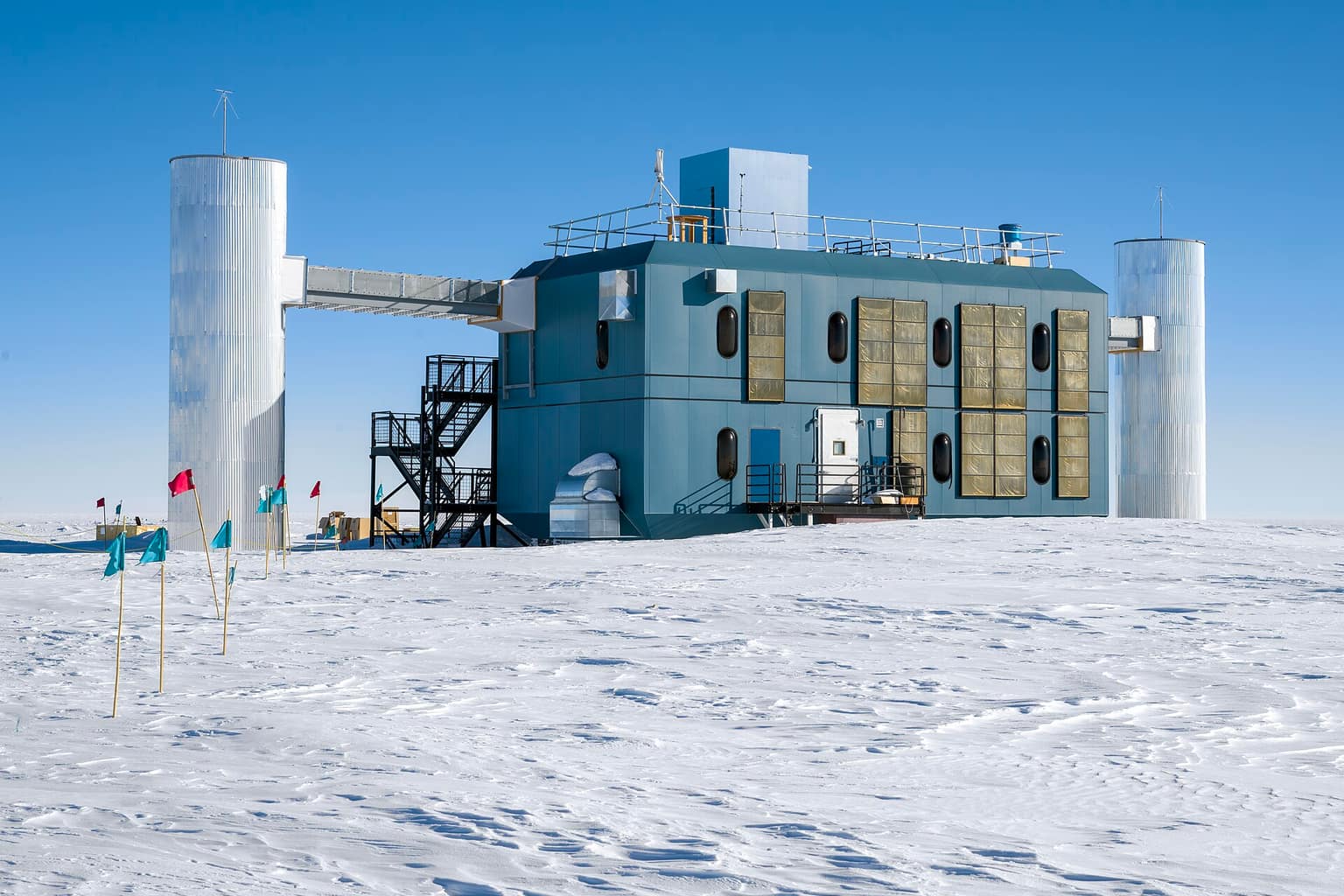
Francis Halzen, the Belgian-American physicist, earned this year’s physics Nobel for his work on IceCube, the world’s largest neutrino detector. Fuller worked with him on an early study involving the observatory. In the 1990s, Halzen envisioned a detector deep beneath Antarctica’s surface, near the US Amundsen-Scott South Pole Station, where fewer air bubbles and impurities would interfere with measurements. Today, thousands of light sensors sit in holes drilled through about one cubic kilometer of ice.
Spotting neutrinos takes a huge volume of matter, because they barely react with anything. When a high-energy neutrino hits the ice, it releases charged particles that generate faint flashes of blue light called Cherenkov radiation. These flashes reveal the neutrino’s energy and the direction it came from. Even so, IceCube detects only a few dozen high-energy cosmic neutrinos each year. Some carry 10 billion times more energy than typical neutrinos produced by the Sun, and one detected by a similar experiment had an energy 200 times higher than that.
Their origins remain unknown. “We don’t really know where that neutrino came from,” Fuller said. “The fact that it got here at all may be saying something profound about the universe.” Neutrinos can escape the extreme conditions near collapsing stars and black holes, and estimates put around one billion neutrinos for every atom in the cosmos. For physicists, the gain is a new way to read the universe, not a new device for daily life.
What changes, and for whom? First for fundamental physics, where new discoveries could reveal more about the Big Bang and the early universe. UC San Diego also takes part in the Simons Observatory in Chile’s Atacama Desert, which studies the cosmic microwave background, the oldest light in the universe, and could provide clues about ancient neutrinos. No timeline is given for either line of research.
Sources — read the originals(Paris time)
Read next
Comments
Loading the thread…
Sign in to leave a comment. Sign in