KM3NeT sets new limits on violations of Lorentz invariance
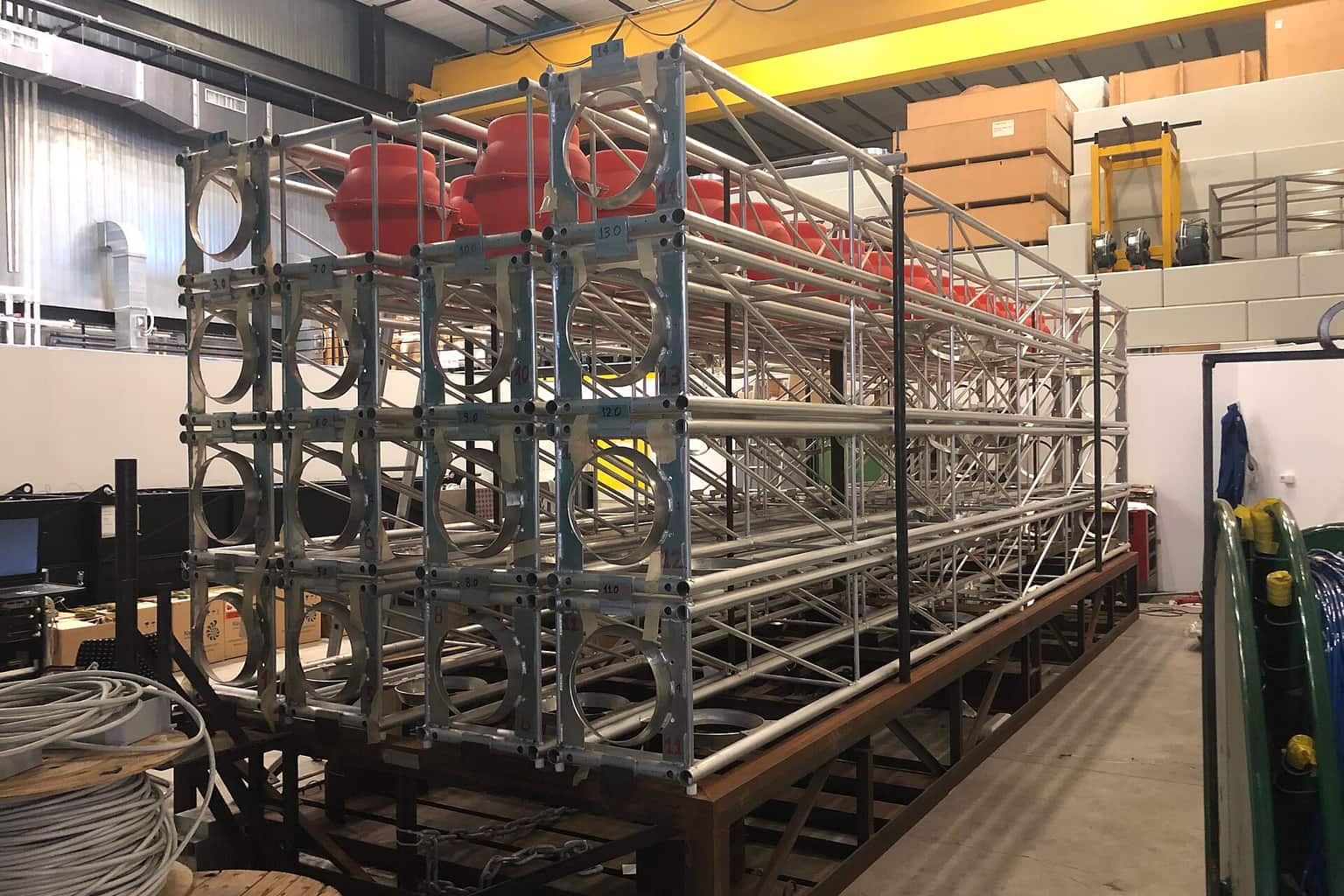
Deep in the Mediterranean Sea, the KM3NeT/ORCA neutrino telescope recorded 5,828 atmospheric neutrino candidate events. The international KM3NeT collaboration used them to test a principle at the heart of Einstein’s relativity: the laws of physics are the same everywhere in the universe. The result is clean. No evidence of a violation turned up, and the team set new experimental limits on how large such violations could be.
The principle is called Lorentz invariance. Some theories that try to reconcile gravity with quantum physics suggest it might not always hold. One family of ideas pictures spacetime, which we normally treat as continuous, as built from extremely small, discrete units. “We still don’t know whether our spacetime is continuous or might be discrete,” says Alba Domi, a researcher at the Erlangen Centre for Astroparticle Physics (ECAP) and one of the study’s two corresponding authors. “Looking for violations of Lorentz invariance is one way to investigate this possibility.”
Neutrinos are well suited to the search. They rarely interact with matter, so they cross enormous distances, even through the Earth. They also change flavor as they travel, a phenomenon called neutrino oscillation, and the odds of each change can be predicted with great precision. A mismatch between observation and prediction would be a sign of new physics, possibly including a violation of Lorentz invariance. The team analyzed 1.4 years of data from the first six detection units of KM3NeT/ORCA, comparing the energies and arrival directions of the neutrinos with theoretical predictions.
Despite that partial configuration, the limits are competitive with those of long-running experiments such as IceCube and Super-Kamiokande. For the first time, the team also set direct limits on certain possible effects involving muon and tau neutrinos, and on how they oscillate between each other. These limits describe how large an effect could be without contradicting the observations. They do not rule out violations altogether.
For physicists building models of quantum gravity, this gives a measured ceiling to test their ideas against. Lukas Hennig, a PhD student at ECAP and the study’s other corresponding author, expects that more data and a larger detector will allow the search for even smaller effects. ORCA is still being expanded toward its full planned configuration, and the researchers give no date for completing it. The next target is KM3NeT/ARCA, which focuses on much higher-energy neutrinos from distant astrophysical sources. Some possible effects grow more pronounced over long distances and at high energies, which makes ARCA a natural follow-up, though Domi notes there are not yet enough astrophysical neutrino events to run that analysis.
Sources — read the originals(Paris time)
Read next
Comments
Loading the thread…
Sign in to leave a comment. Sign in