Sheffield lab recreates Lycurgus Cup's colour-shifting glass
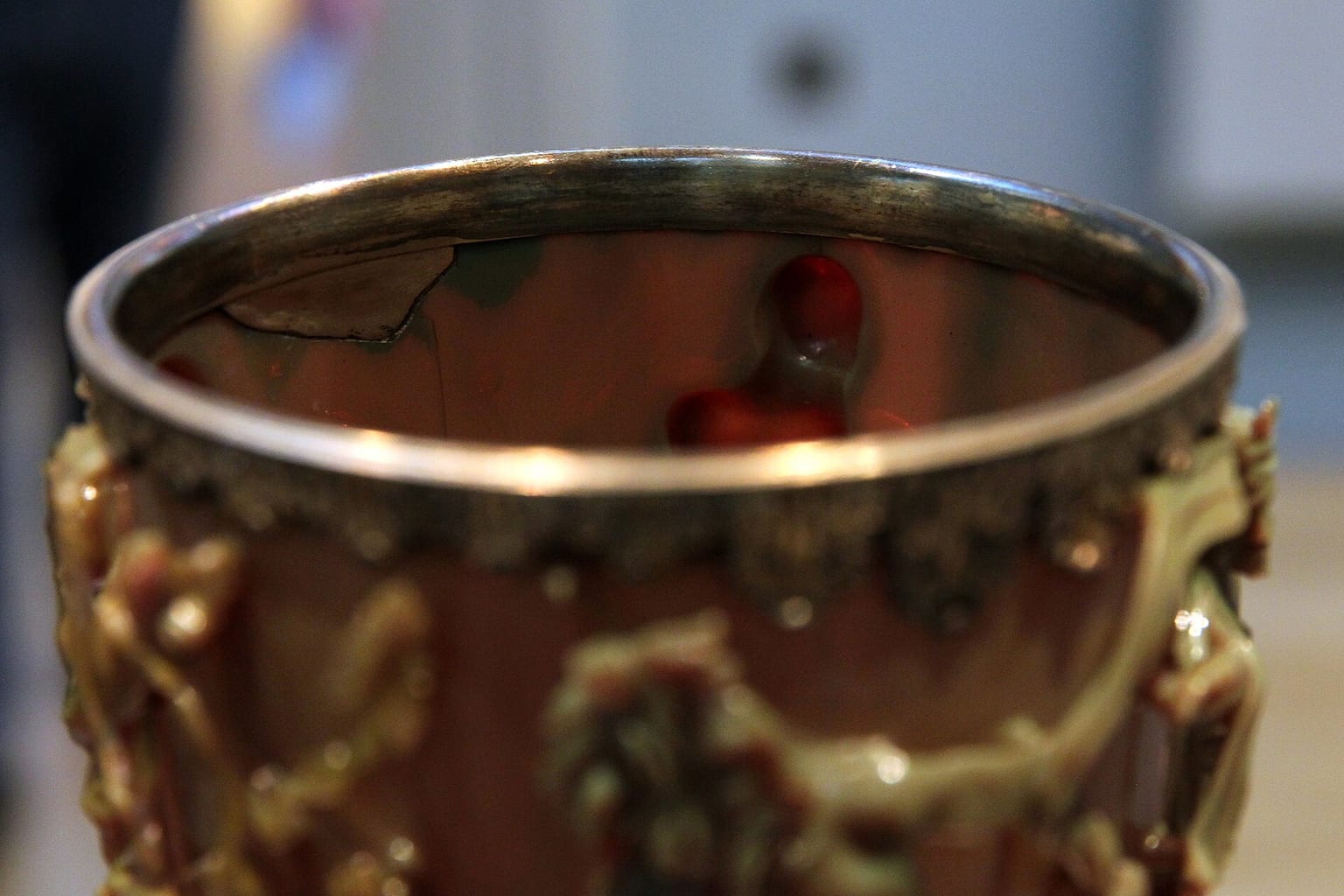
For Dr Lisa Hollands, the hard part was never the glass itself. It was getting tiny amounts of gold and silver into it, in exactly the right form. Hollands is a technician at the University of Sheffield, and for more than 25 years she has worked with glass. When the project manager Christina Metcalfe asked the university to try to reproduce the Lycurgus Cup for its LightFest in 2025, she accepted the challenge.
The Lycurgus Cup, a 4th-century Roman object held by the British Museum, is made of 'dichroic' glass. It looks jade green when light falls on it from the front and ruby red when light passes through it. It is one of only 40 surviving glass cage cups from its period, and the only one with this effect. The mechanism is understood in outline. Gold and silver nanoparticles, smaller than the wavelengths of light, absorb light strongly and show colours that depend on their size and shape. What nobody had was a reliable way to produce them on demand, and many earlier attempts had varied in their results.
Hollands began with a base glass made from modern materials, designed with the help of the Roman glass expert Professor Caroline Jackson to resemble what the Romans might have used. She then ran many experiments with different furnace types, starting materials and oxygen levels, and even added sugar. The result was a glass that appears opaque green in reflected light and red when a light shines through it. The university says this reproduces the effect of the original.
The glass has since become an artwork. Metcalfe's team commissioned Elliot Walker, a glass artist who won season two of Netflix's 'Blown Away', to make a sculpture with Hollands' recipe. Walker blended the Lycurgus story with the Farnese Atlas, replacing the globe with a cup, so that the piece could show the dichroic glass in a blown form. It will be unveiled at the Millennium Gallery from 6 to 15 November 2026, during the university's Festival of the Mind. It will then go on permanent display at the Turner Museum of Glass.
For most visitors, the sculpture will be a way to see what nanoparticles can do inside glass. For the researchers, the gain is more practical. The university says the scientific understanding gained will feed into new photonic materials, which manipulate light, and into advanced glasses for radioactive waste management. Those applications are described as expected, not yet in use, and the piece itself is mainly decorative.
Sources — read the originals(Paris time)
Read next
Comments
Loading the thread…
Sign in to leave a comment. Sign in