Simulated laser accelerator yields bright X-rays for biology
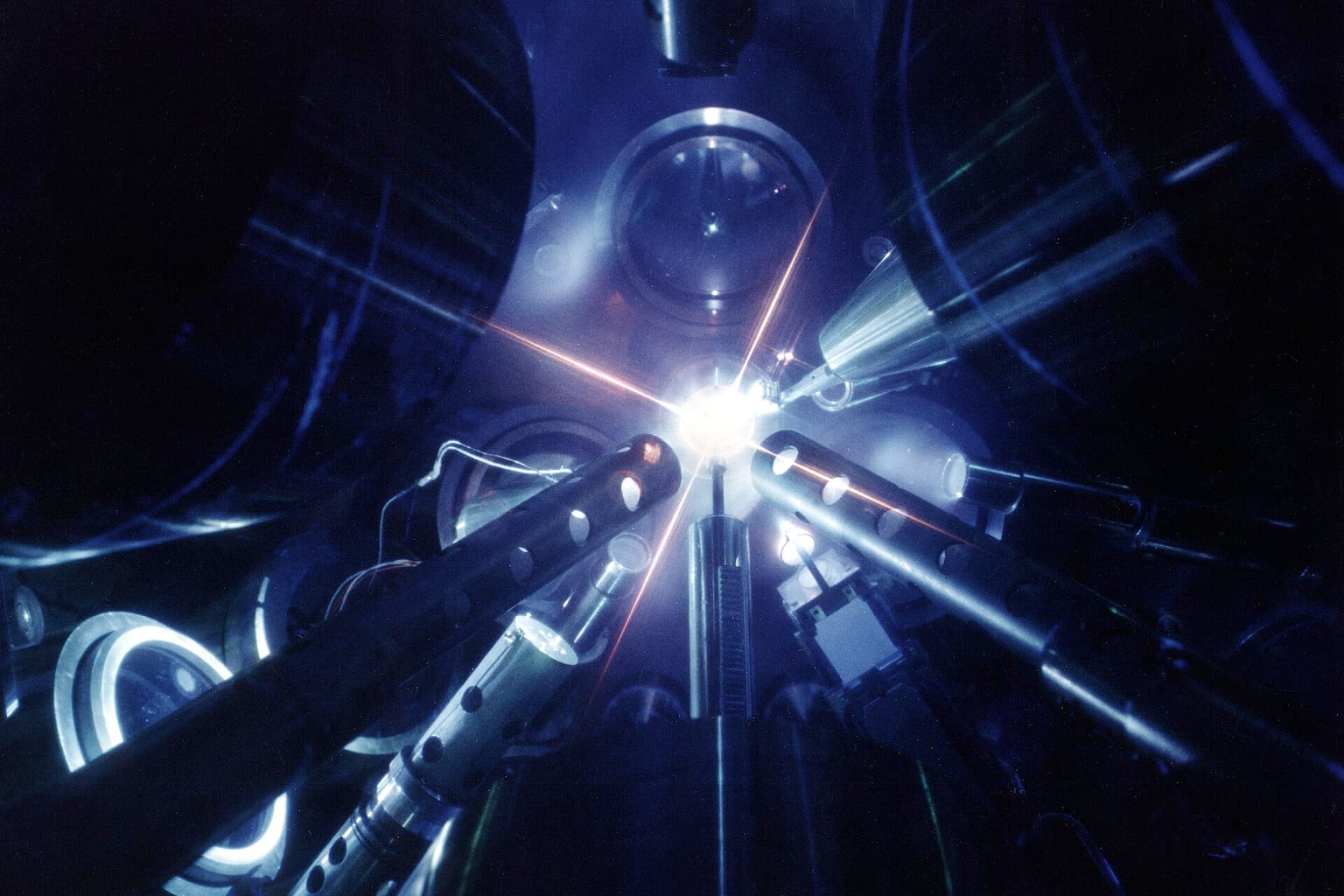
Between 2.3 and 4.4 nanometers lies a band of X-rays called the "water window". Water lets these rays pass almost untouched, while the carbon and nitrogen of biological molecules absorb them strongly. That contrast makes the band ideal for examining living samples in their natural, watery state, but until now only free-electron lasers, machines that are kilometers long, have produced it at the quality and intensity needed.
A team from Heinrich Heine University Düsseldorf (HHU), the ELI Beamlines research facility in Czechia and the University of Strathclyde in Scotland has now shown in model simulations that another route could work. In a laser-plasma accelerator, a high-intensity laser pulse creates a plasma wave in a gas. Its field is so strong that it pushes electrons to almost the speed of light within just a few centimeters. The electrons then pass through a magnetic undulator, a row of alternating magnets that forces them onto a wavy path and makes them emit light. In the simulations, the resulting X-ray flashes form within just a few meters. The study appeared in the journal Nature Communications.
The key step is the electron beam. Whether such a source can work as a free-electron laser depends mainly on the quality of the electrons, and according to Dr. Fahim Habib of ELI, the hybrid design could supply the necessary conditions. Lily Berman, the study's lead author and a doctoral researcher at Strathclyde, says the simulations also suggest the process should be robust and adjustable.
What changes is the scale. Dr. Bernhard Hidding, who leads the group at HHU, says the system is very compact and could be built for a fraction of the cost of conventional accelerators. It could therefore be sited at universities and research facilities, or used commercially, and water-window imaging and spectroscopy could spread beyond a few major national laboratories. These are the team's expectations, and they rest on simulations. The next step is the experiment, which the team says will come in the near future.
Sources — read the originals(Paris time)
Read next
Comments
Loading the thread…
Sign in to leave a comment. Sign in