Soft robot arms predict their next move
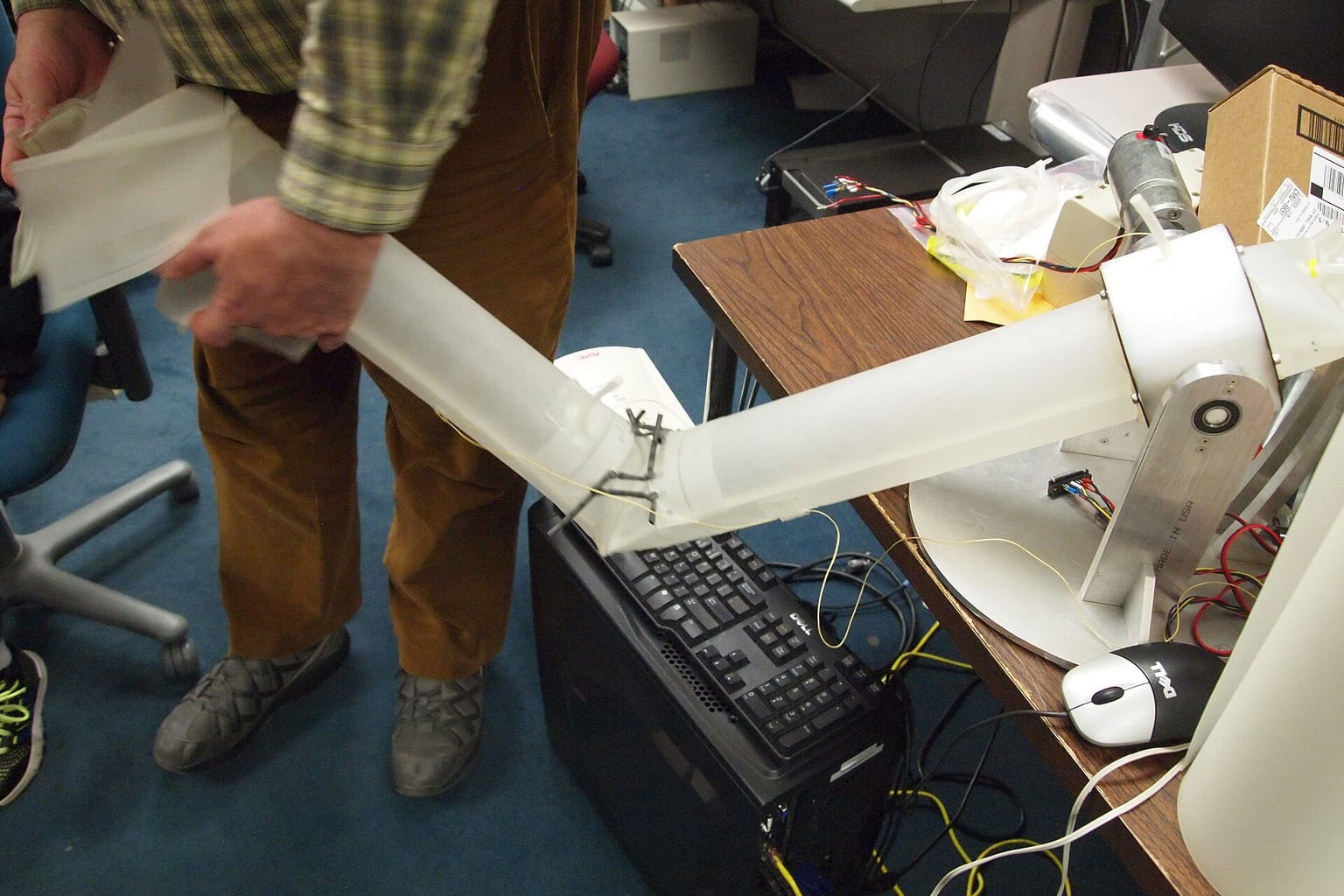
Picture a robot arm that bends like an elephant's trunk. Smooth and flexible, it can slip into tight spaces and pick up fragile objects. What it has been slow to do is know where it will be a moment later. A team at Peking University has built a hybrid forecasting method that keeps that prediction on track, even when the arm moves faster than the model was trained for.
The difficulty is structural. A learned model predicts one small step at a time, and each step starts from the previous one, so small errors pile up. After 200 steps, the forecast can be far off, and the controller then works from a false picture of the arm's own body. Before a flexible robot moves, its controller rehearses possible commands in a computer model and picks the best one, so a bad forecast means a bad choice.
The fix gives the forecast a reference point. A first model, the anchor, learns the shape the arm settles into when its controls are held steady, and at every step it pulls the prediction back toward that shape, so errors cannot snowball. The arm does swing and bend on its way to rest, so a second, lightweight model, the correction, learns those motions from the arm's data. Together they form a hybrid model. The work was presented at Robotics: Science and Systems (RSS 2026), held in Sydney from July 13 to 17, 2026, and published in the conference proceedings.
The team first tested the method in simulation, on a three-dimensional arm driven by cables. Asked to predict 6 seconds of motion, or 200 steps, well beyond what it had been trained on, the hybrid model cut its error by more than a quarter compared with the anchor alone. It also beat the correction alone and never lost track in any of the 19 tests. Simulation is the gentler ground, so the real test came next.
That test used a hydraulic soft tail shaped like a fish's, which swings from side to side when water is pumped in. There, the hybrid model's error was half or less that of the anchor alone, and a quarter or less that of the correction alone. On standard benchmark tests it finished every prediction, while a competing method sometimes failed. The results come from one tail, built by the team itself.
For a controller, a forecast it can trust changes the order of the work. It can run many possible moves on the computer first and choose the safest before the real arm moves, and a robot that foresees how its body will bend can plan a careful move in advance. That matters first for flexible arms in places rigid machines struggle to reach, such as tight spaces, and for objects that break easily. The study does not say when such arms could leave the lab.
Sources — read the originals(Paris time)
Read next
Comments
Loading the thread…
Sign in to leave a comment. Sign in