Trapped light can order a 1D magnet, in theory
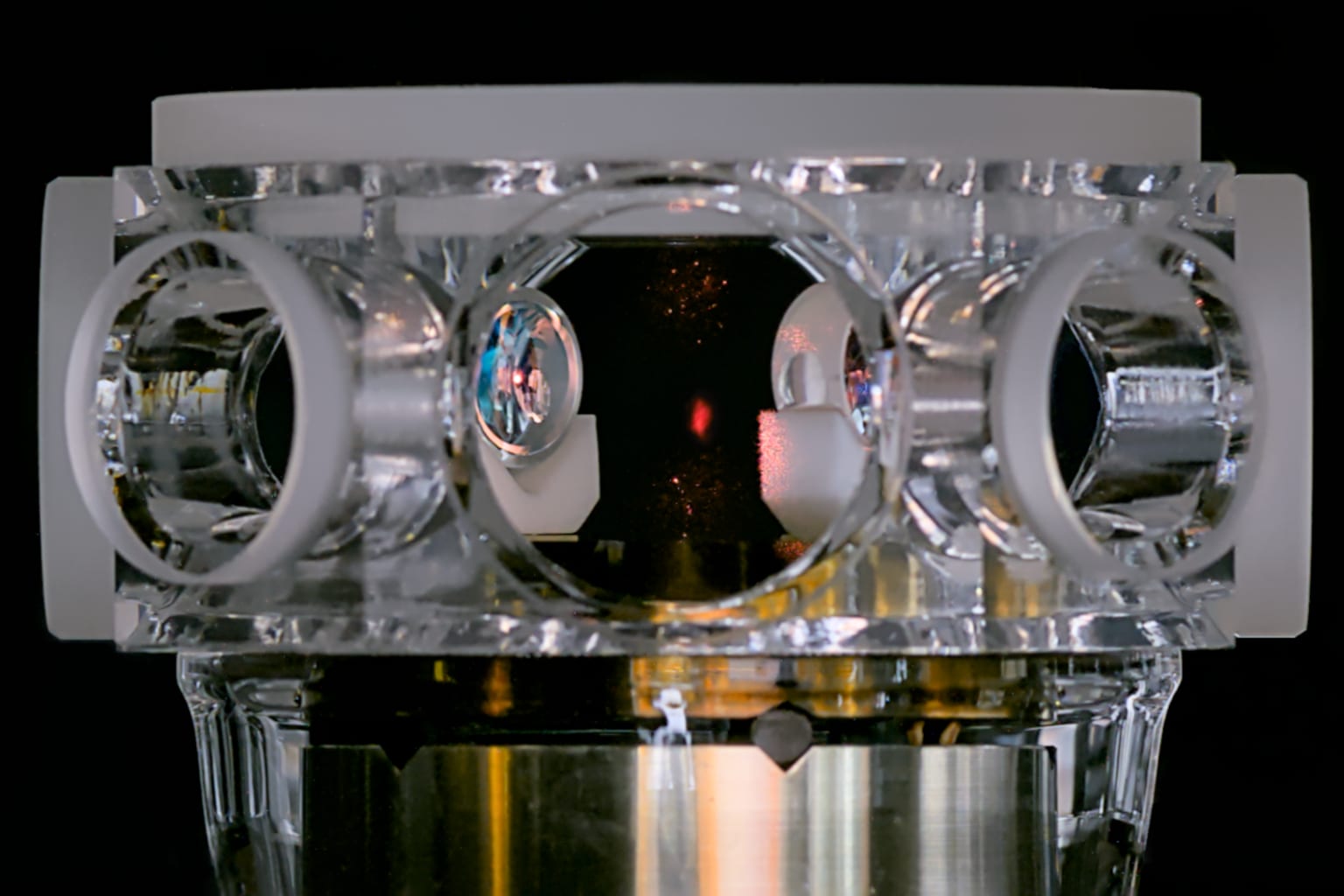
Put a chain of tiny magnets in a box that traps light, and the chain can start to order itself. That is the result a team at Yokohama National University reports in Physical Review Research. The chain cannot do this alone: since Ernst Ising's work in 1925, a one-dimensional chain of small magnetic particles, each interacting only with its nearest neighbours, has been known to show no magnetic phase transition at finite temperatures.
The Ising chain has long been a basic math tool. Physicists know that magnetic transitions occur in two or more dimensions, and the one-dimensional case stays the simplest reference point. Meanwhile, cavity systems in which matter and light are trapped and strongly interact have opened new questions. In the last decade, ultra-strong light-matter coupling has moved from theory to experiments with phonons, superconducting circuits, organic molecules and magnons. Scientists have been especially interested in the superradiant phase transition, the spontaneous build-up of a coherent electromagnetic field in thermal equilibrium, caused by the coupling of light and matter.
The team, which included Shuntaro Otake and Bamba, chose the most minimal route: a one-dimensional classical spin model coupled to a single cavity photon mode, with the interactions that real materials have but simple models usually leave out. The model is exactly solvable, which means its behaviour can be computed in closed form in the thermodynamic limit, without approximation. The construction makes the mechanism explicit. Photons couple all the spins to one another, and those long-range links, together with the spins' own interactions, produce a second-order magnetic phase transition at a specific temperature. The team derived the magnetization, the photon number and the critical temperature analytically. Earlier studies of cavity-coupled one-dimensional systems focused on absolute zero; this one examines finite temperatures, where thermal equilibrium matters.
For physicists, the immediate gain is a reference point: an exact case against which more complex light-matter systems can be tested. For experimentalists, the work names candidate platforms, superconducting-qubit arrays and one-dimensional magnets coupled to sub-terahertz cavities, but the sources give no timeline for building them. Bamba's stated aim is to understand and control the equilibrium phases of light and matter, and to help guide experiments toward new quantum optical technologies. That aim is long-term; the paper is theoretical.
The next step is already set out. The team wants to add energy loss to the model and to study more realistic systems. Until those extensions are done, the result stands as an exact theoretical demonstration that light can create magnetic order where the chain alone cannot.
Sources — read the originals(Paris time)
Read next
Comments
Loading the thread…
Sign in to leave a comment. Sign in