A simple screen fix curbs damage to copper solar cells
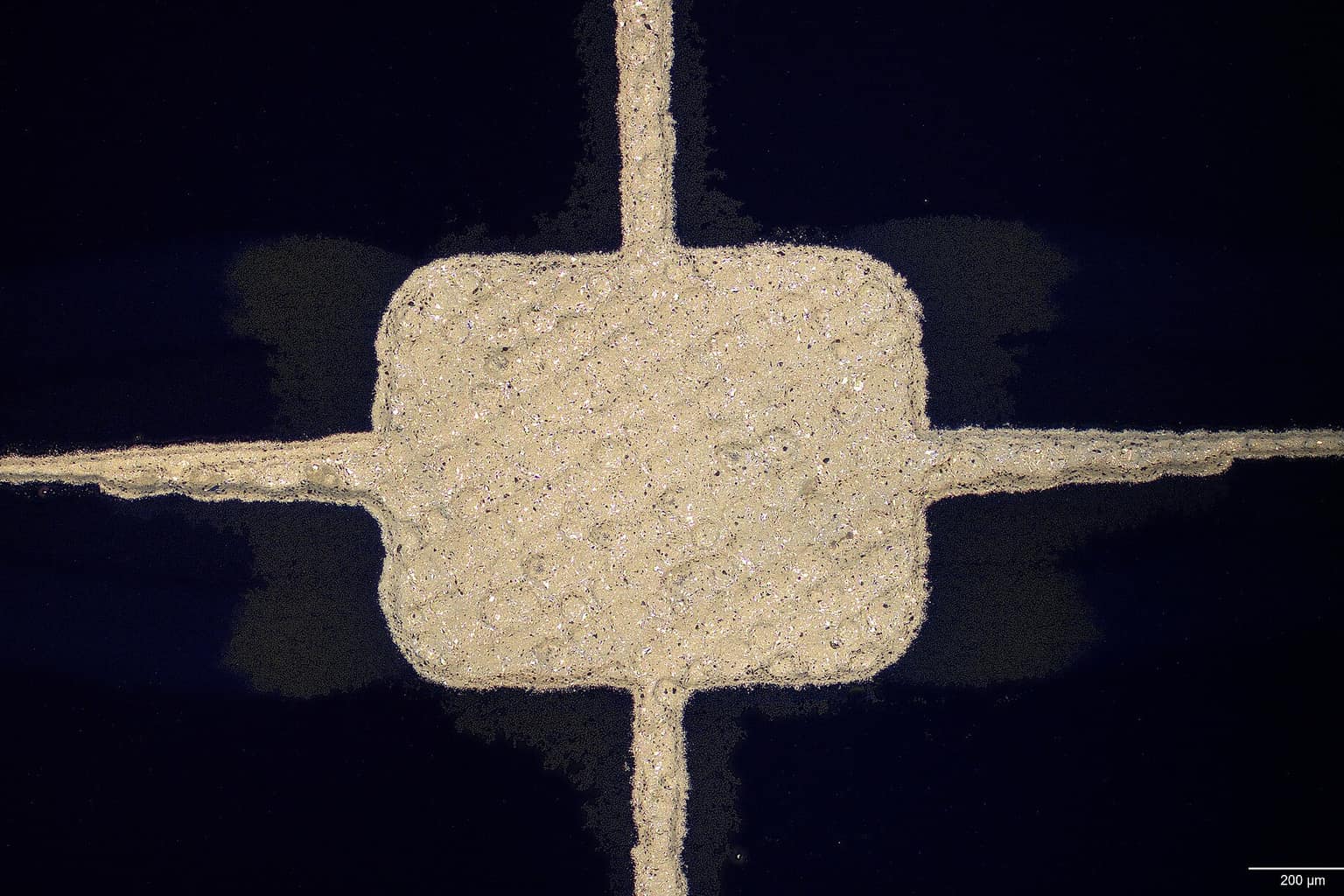
On a screen printer, a fine metal mesh presses onto the silicon wafer again and again. For copper-plated solar cells, that repeated contact slowly wears the cells down. Researchers in China have traced the damage to the mesh itself, and they have found a fix that sits on the screen: a thin buffer layer that keeps the mesh off the wafer. With a coverage of 4.7%, the cells held up best in their tests.
The silicon heterojunction (HJT) cell is one of the more promising designs in solar, and its metal contacts can be made of copper instead of silver, a far more expensive metal. The screen printing step that applies the photoresist, a light-sensitive coating, works differently from the printing of silver paste. In silver printing, an emulsion layer covers most of the screen and keeps the mesh away from the wafer. Full-area photoresist coating uses a screen without that emulsion, so the mesh touches the wafer across its whole surface on every cycle. In commercial production, earlier investigations had seen efficiency slide from 26.2% to 25.7% over 15,000 consecutive printing cycles. The losses came mainly from voltage and fill factor, while current and electrical resistance barely moved.
Using three-dimensional confocal microscopy, the team found that the cause was progressive wear of the mesh knuckles, the points where the threads cross. As they flattened, their contact area with the wafer grew, and the pressure on the passivation layers rose. Scanning electron microscopy showed no visible scratches, but photoluminescence measurements confirmed more recombination, meaning charges were lost more often. The damage pointed to the sensitive interface between amorphous and crystalline silicon. Lifetime loss rose from 0.61% with a new screen to 11.0% after 15,000 cycles.
The researchers built an emulsion buffer layer and tested six patterns, covering from 2.9% to 16.6% of the screen. More coverage meant more protection but poorer ink distribution, so the team had to choose a balance. At 4.7%, lifetime loss was limited to 0.41% after 10,000 printing cycles, and coating stayed relatively even. The researchers attribute the gain to the layer preventing direct contact between mesh and wafer.
The work comes as copper gains ground against silver. In April 2026, researchers at China's Nankai University reported a silver-free HJT cell at 25.2% efficiency, using plasma-treated interfaces and copper electroplating. At Germany's Forschungszentrum Jülich, a fully copper-metallized HJT cell reached 23.08%, with a relatively small penalty against its silver twin, and cells combining silver-copper paste at the front with silver at the rear reached 23.95%. Further work on processing and electrical performance is still needed.
For a maker of copper-plated HJT cells, the change lies in the screen rather than in the line, and the researchers present it as a practical way to improve manufacturing reliability. No date is given for adoption in factories.
Sources — read the originals(Paris time)
Pages consulted while writing
Read next
Comments
Loading the thread…
Sign in to leave a comment. Sign in