Bleached corals fully recover in seven weeks, lab study finds
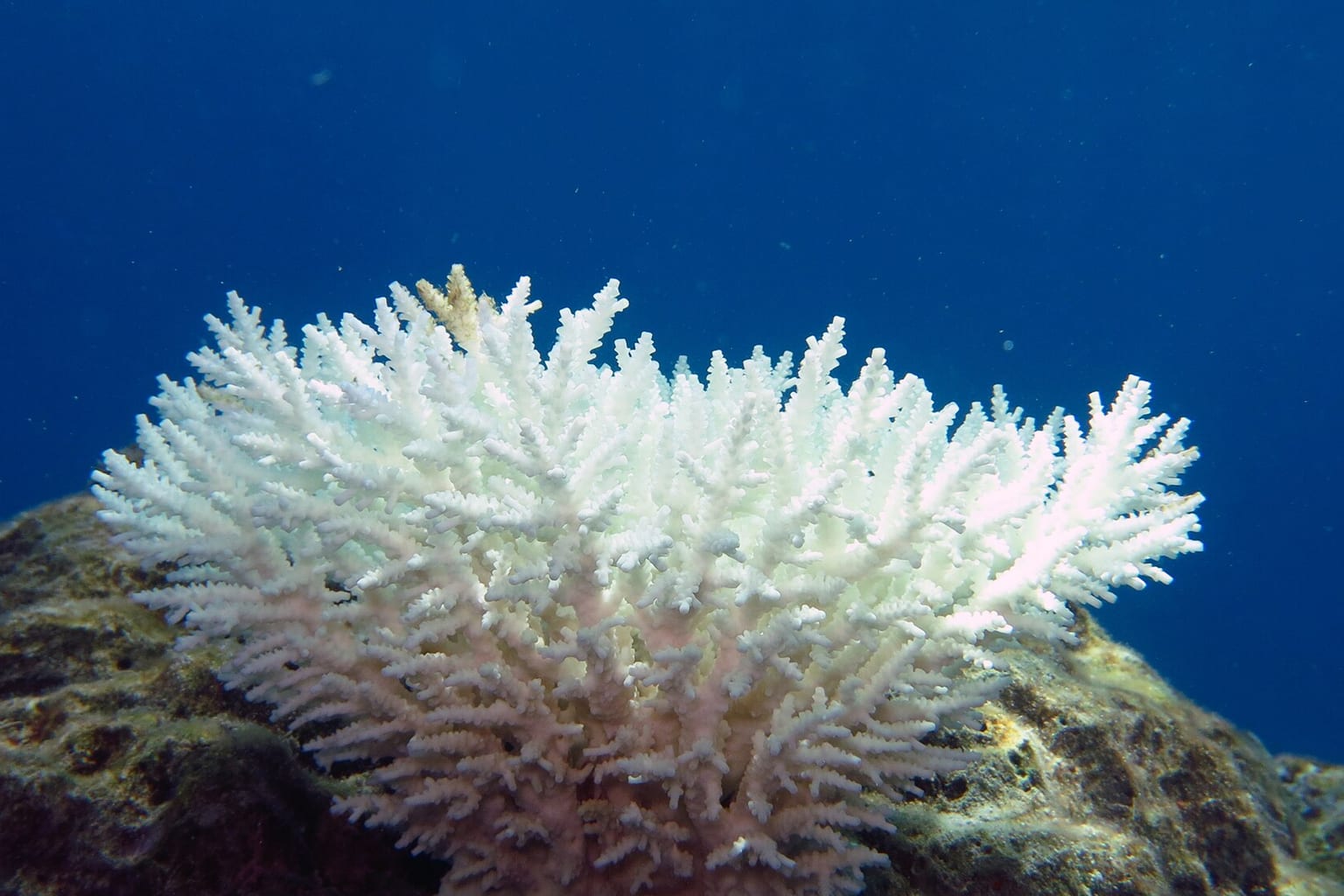
Two coral fragments sat in a tank in Steve Palumbi’s research lab. One was bleached, nearly white. The other was healthy. Both had been cut from the same colony, and in 2025 they tipped over and came to rest touching each other. Where they met, colour came back to the pale one. That accident is now the starting point of a study published in Science Advances, which reports that bleached corals can fully recover within seven weeks after brief contact with healthy ones, in laboratory conditions.
When waters warm, corals expel the algae that live in their tissues and supply them with energy and colour. Without those partners, they turn pale, starve and become vulnerable to harmful algae. If they survive, recovery can take months to years. Some estimates say corals could disappear within a few decades as marine heat waves grow more frequent and intense. For several decades, researchers have tried to protect them with heat-tolerant breeding, coral nurseries and transplanted microbiomes. “Bleached corals are often considered a lost cause because recovery after a heat wave is very slow, if it happens at all,” said Fiorenza Micheli, a marine scientist at Stanford and faculty adviser to Collins.
Collins built the experiment around that observation. He assembled 10 pairs of fragments from the same animal and placed five pairs in direct contact. The other five had gaps of just a few millimetres. The touching pairs recovered in full, and the separated bleached fragments died. Under a microscope, the team saw that microscopic channels in the tissue align shortly after contact, forming a route between the two corals. Beneficial algae and the nutrients they produce then move through it, reaching the bleached fragments within three days. Palumbi offers a human comparison: genetically identical corals recognise each other, and their tissues fuse. “We see something similar in humans. Organ transplants are often successful if the donor is your identical twin.”
The team then tested how long contact had to last. After one week, and in some cases after just five days, the bleached fragments had received enough algae to finish recovering on their own. Once separated, they still took about seven weeks to recover, the same time as pairs kept in contact. The team concluded that the algae multiplying inside the bleached fragment, rather than the supply from the healthy one, primarily drove the rest of the recovery. In the second week of contact, those algae doubled every four days, roughly ten times faster than in wild corals. “Once beneficial algae enter bleached corals, they don’t just spread out,” Palumbi said. “They flood in and start dividing at the fastest rates seen in corals.”
What this changes, and for whom, is still limited. The method would matter first to teams that restore degraded reefs, because a short contact between bleached and healthy corals could, in principle, be used to kick-start recovery. Micheli said the team hopes the work will inspire new methods to restore corals rapidly. But the study was done in a laboratory, on fragments of the same colony, and it reports no trial on a natural reef. It does not say whether the approach would work outside a tank, or with corals that are not genetically identical, and it gives no timeline for any field use.
Sources — read the originals(Paris time)
Read next
Comments
Loading the thread…
Sign in to leave a comment. Sign in