Fiber-optic cable picks up bowhead whale calls for the first time
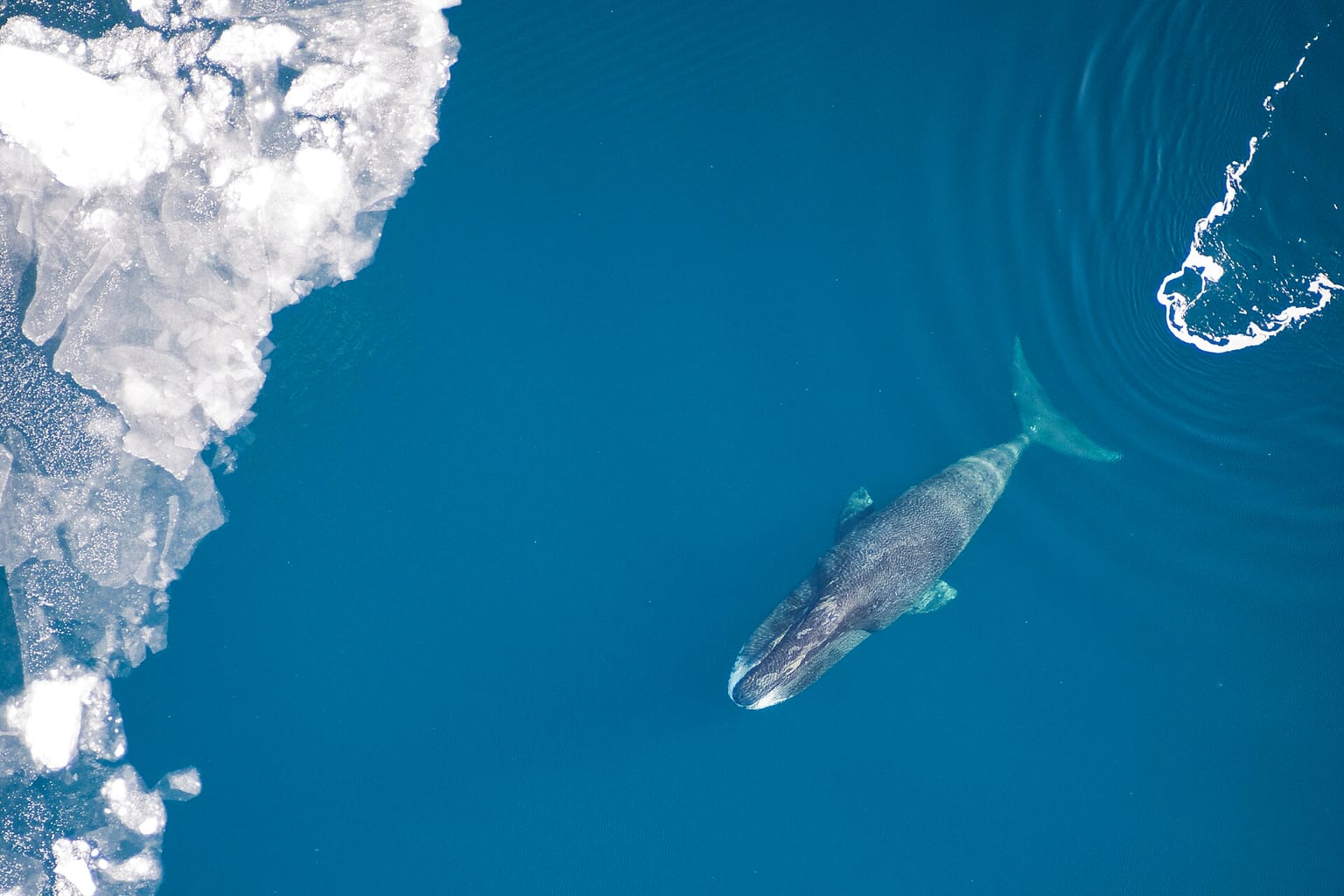
Léa Bouffaut spent weeks combing through terabytes of recordings, looking for a sound her method had never been shown to capture. The recordings came from a fiber-optic cable off Utqiaġvik, on Alaska's North Slope, where Iñupiat whalers have hunted bowhead whales for thousands of years. The cable is owned by Quintillion and was laid for telecommunications. In spring 2026, working with the Barrow Whaling Captains Association and the North Slope Borough Department of Wildlife Management, the Cornell bioacoustics researcher made what her team calls the first-ever detections of bowhead whale vocalizations in distributed acoustic sensing (DAS) data.
DAS sends laser pulses down a fiber-optic line and measures the tiny changes that passing sound waves cause in it. Along a single cable, that turns many miles of seafloor into a dense network of virtual listening points, and each whale species leaves its own acoustic signature. The method had mainly been proven on blue and fin whales, which call loudly below 100 hertz. Bowhead whales, like North Atlantic right whales, call between roughly 150 and 300 hertz and at lower intensity, which made them harder to pick out. Bouffaut had been the first to document blue and fin whales on fiber-optic cables, in 2022, and she wanted to know whether the same tool could capture all baleen whales.
The earlier proof came from the Arctic. In July and August 2020, scientists tapped an unused fiber-optic cable along Norway's Svalbard archipelago and recorded for 40 days of round-the-clock data, which Bouffaut and Kriesell of NTNU's Department of Electronic Systems later analyzed. An analysis of an Arctic fiber cable published on nature.com reports whale detections along at least 95 km of cable, and a trade report on the Svalbard work adds that the detections were checked against ship AIS tracking data, the automatic identification system that logs vessel positions. These are the lower-frequency calls. The Alaska test pushed the method toward the harder band.
“Being able to detect bowhead whales on a telecommunication cable is the proof of concept we need to show that DAS can be used to monitor all baleen whales,” Bouffaut said. For now, only her team reports these bowhead detections, and the frequency gap they close is the one that made the method uncertain. The technique will not replace underwater microphones, she stresses; it complements them and can scale monitoring up.
For scientists who track whales, the gain is reach. Bouffaut says undersea cables could open new ways to estimate populations, time migrations and study how Arctic whales respond to rapid environmental change, and she stresses real-time access “over tens of kilometers and from land.” Telecom and offshore energy operators already watch their cables for safety, so the same streams of data, which is what dual-use infrastructure means, could serve environmental compliance and wildlife protection. The team gives no timeline for any of these uses.
In a review published in Methods in Ecology and Evolution in 2026, Bouffaut sets out where the field stands and recommends how to move DAS from proof of concept to an operational tool for whale management. Her call is addressed to scientists, industry partners and regulators together: “We now have the technical blueprint to turn global undersea infrastructure into a global network for ocean conservation.” The next step is that collaboration, and the move from one cable test to a network of cables.
Sources — read the originals(Paris time)
Pages consulted while writing
Read next
Comments
Loading the thread…
Sign in to leave a comment. Sign in