First evidence that clogging is a phase transition, in superconductors
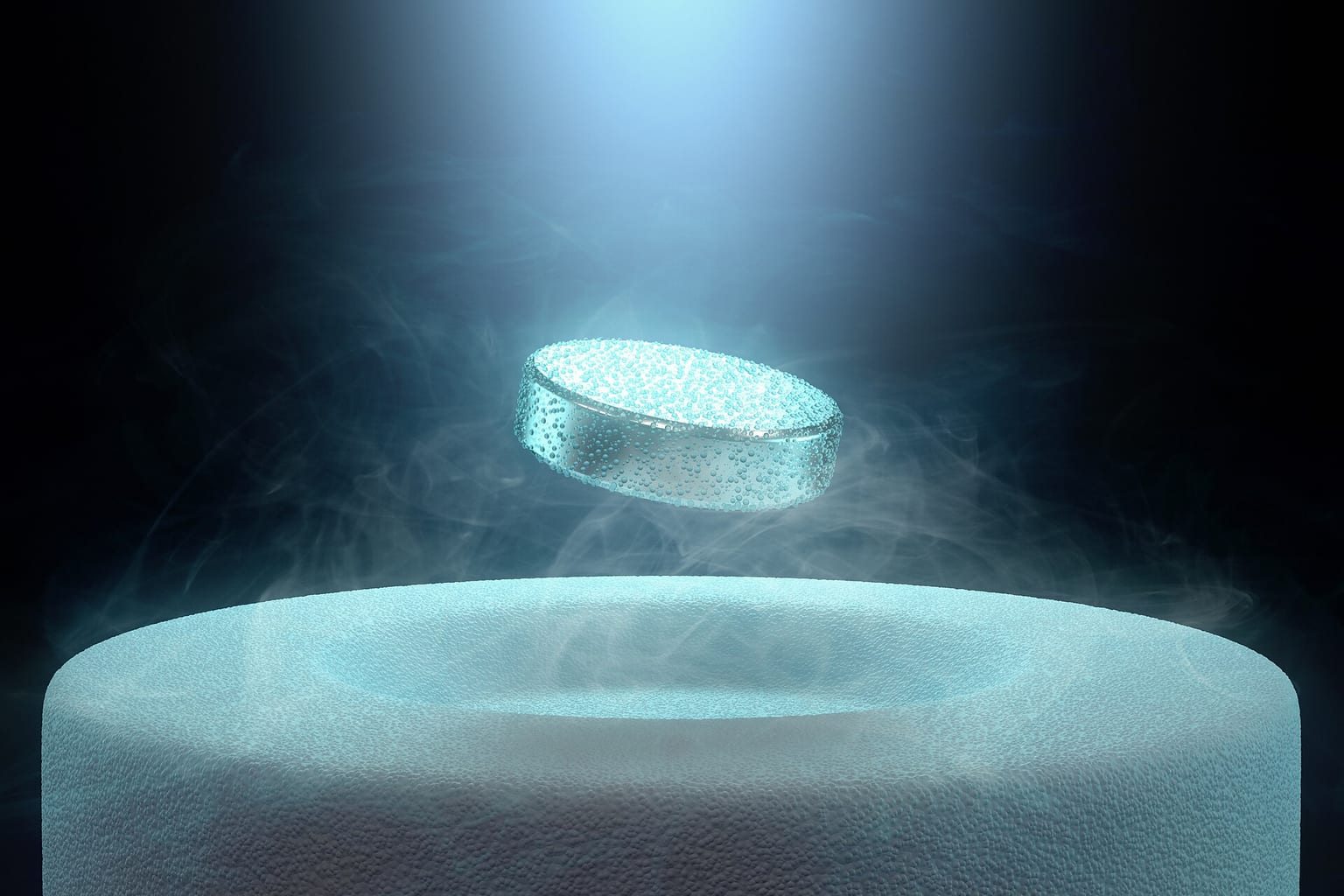
Clogging is what happens when a flow slows and then stops, with particles jamming at a bottleneck. Physicists have long suspected that the switch from free flow to complete blockage follows the rules of a phase transition, but the idea rested on simulations. A team at the Institute of Science Tokyo has now measured it directly, using superconducting vortices.
The study, led by former graduate student Takahide Minemura and professor emeritus Satoshi Okuma, drove vortices through thin films of amorphous molybdenum-germanium (MoGe) with a direct current. Material defects act as pinning sites that hold vortices in place, and trapped vortices can form bottlenecks that block the others. To tell clogging apart from ordinary pinning, the researchers applied two successive current drives, in parallel or opposite directions, and tracked the voltage over time. The fast relaxation came from clogging, the slow one from pinning.
The results show that both relaxation times diverged as the driving current approached a critical value, following a power law. The critical current for clogging coincided with the depinning current, the point where pinned vortices break free, within experimental uncertainty. The critical exponents of both transitions resembled those predicted for two-dimensional directed percolation, a known family of nonequilibrium phase transitions. The paper's abstract states that, to the authors' knowledge, no experimental study had previously tested this prediction. It was published in Communications Physics on 25 September 2026.
For engineers and biologists, the value lies in prediction. If clogging and depinning share a critical point, the same framework could apply to granular flows, colloids and active matter, which the team names as possible targets. Okuma points to industrial plants, infrastructure pipelines and blood vessels as places where blockages cause serious problems. These applications remain prospective: the work rests on one experiment in one material, and no independent reproduction has been reported.
Further research could explore how these critical dynamics vary across different materials and transport environments. The team has not announced a timeline.
Sources — read the originals(Paris time)
Pages consulted while writing
Read next
Comments
Loading the thread…
Sign in to leave a comment. Sign in