Floating solar rows spaced 0.5 m apart cool best
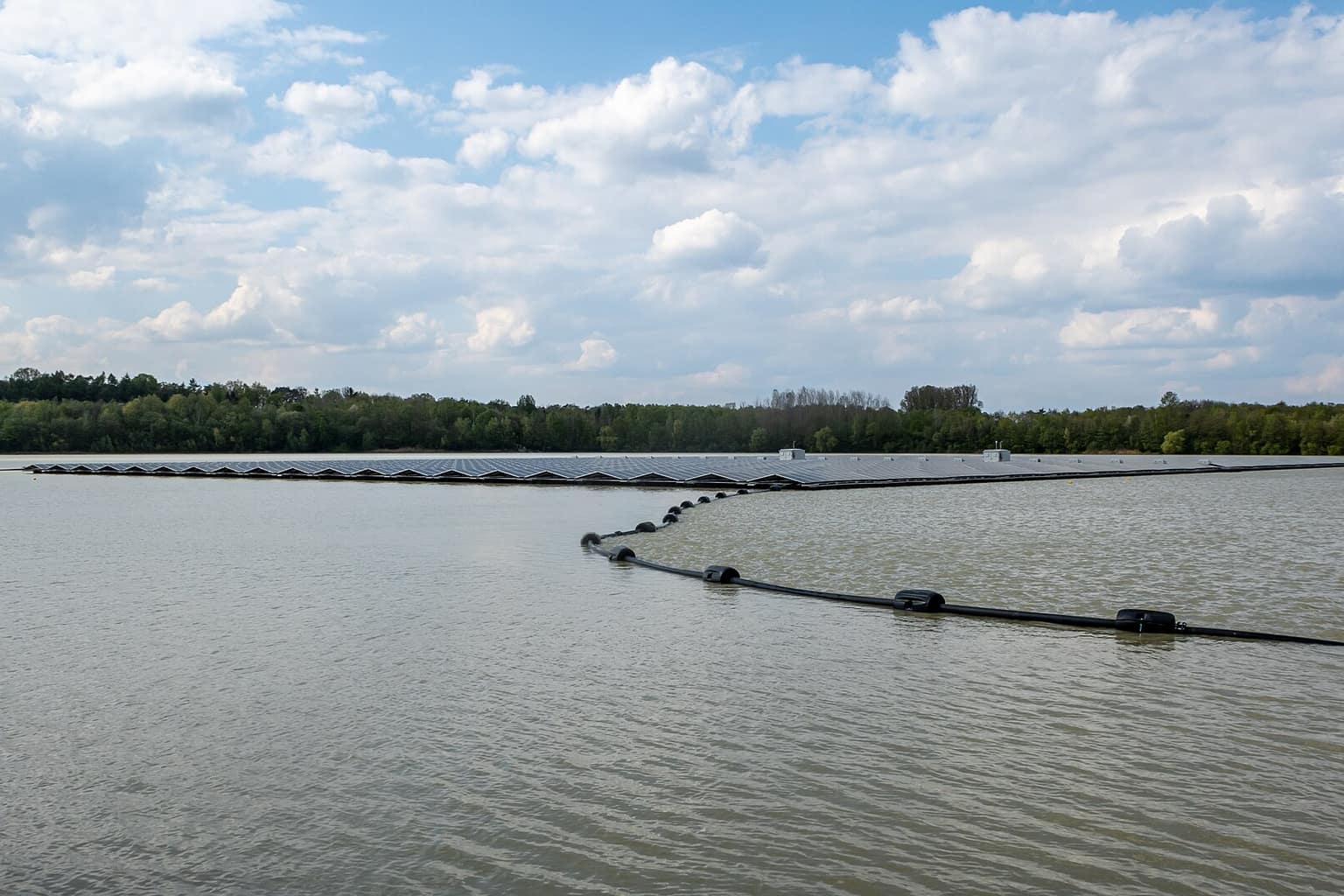
Picture a row of solar panels floating on a reservoir, tilted at 15 degrees and a quarter-metre above the water. Row spacing is usually decided by installed capacity, shading and the floating platform. A study led by scientists from the University of Naples Parthenope and the University of Campania Luigi Vanvitelli has added a fourth criterion: how the panels stay cool. Modelling a proposed installation at the Occhito Dam reservoir in southern Italy, they found that rows about 0.5 metres apart gave the best cooling. At a 3.5 m/s wind, the average module temperature reached 27.16 °C, against 31.07 °C for the most compact arrangement.
Heat is the problem the spacing attacks. Crystalline silicon panels, the standard type, typically lose about 0.3% to 0.5% of their efficiency for every 1 °C rise in cell temperature. Each row creates an aerodynamic wake behind it, a zone of disturbed air that blocks the flow that would carry heat away from the next row. Packed too tightly, the air stalls between rows. Spaced too widely, the air recovers fully but does not speed up as it passes between rows. At the intermediate spacing, airflow between the first two rows reached roughly 2.5 to 3.0 m/s at 3.5 m/s wind, against 1.0 to 1.5 m/s in the compact layout.
The gain is not uniform across the array. The middle row, exposed to wakes from upstream and to airflow recovery from both sides, was the most sensitive to spacing. At 3.5 m/s it reached 23.30 °C with the 0.5 times spacing, against 29.66 °C in the most compact layout and 30.17 °C in the widest. The relationship is not linear: the widest layout performed worst at 1.5 m/s, at 37.74 °C, against 37.02 °C for the best configuration. The researchers attribute this to weaker airflow acceleration between rows, and conclude that the best spacing depends on site-specific conditions, in a balance between wake recovery and acceleration.
For developers of floating solar on inland reservoirs in Mediterranean climates, where summer heat and variable winds affect module temperatures, the study makes row spacing a thermal decision as well as a capacity one. The authors say it challenges the assumption that proximity to water alone ensures good cooling. The study sets no timetable for the Occhito project, which remains a proposal.
The model has clear boundaries. It is two-dimensional, with three module rows, two wind speeds and inputs from hourly ERA5 reanalysis weather data for 2024, which describe an annual average air temperature of 15.37 °C and a water temperature of 14.67 °C. It does not account for three-dimensional turbulence, changes in wind direction, shading, detailed floating support structures or the full range of weather over a year. The researchers warn against treating the 0.5 times spacing as a universal design recommendation. Those untested factors are the next questions any design team would need to answer before applying the result.
Sources — read the originals(Paris time)
Read next
Comments
Loading the thread…
Sign in to leave a comment. Sign in