In Lab, Lasers Sculpt Rubidium Gas So a Light Beam Stops Spreading
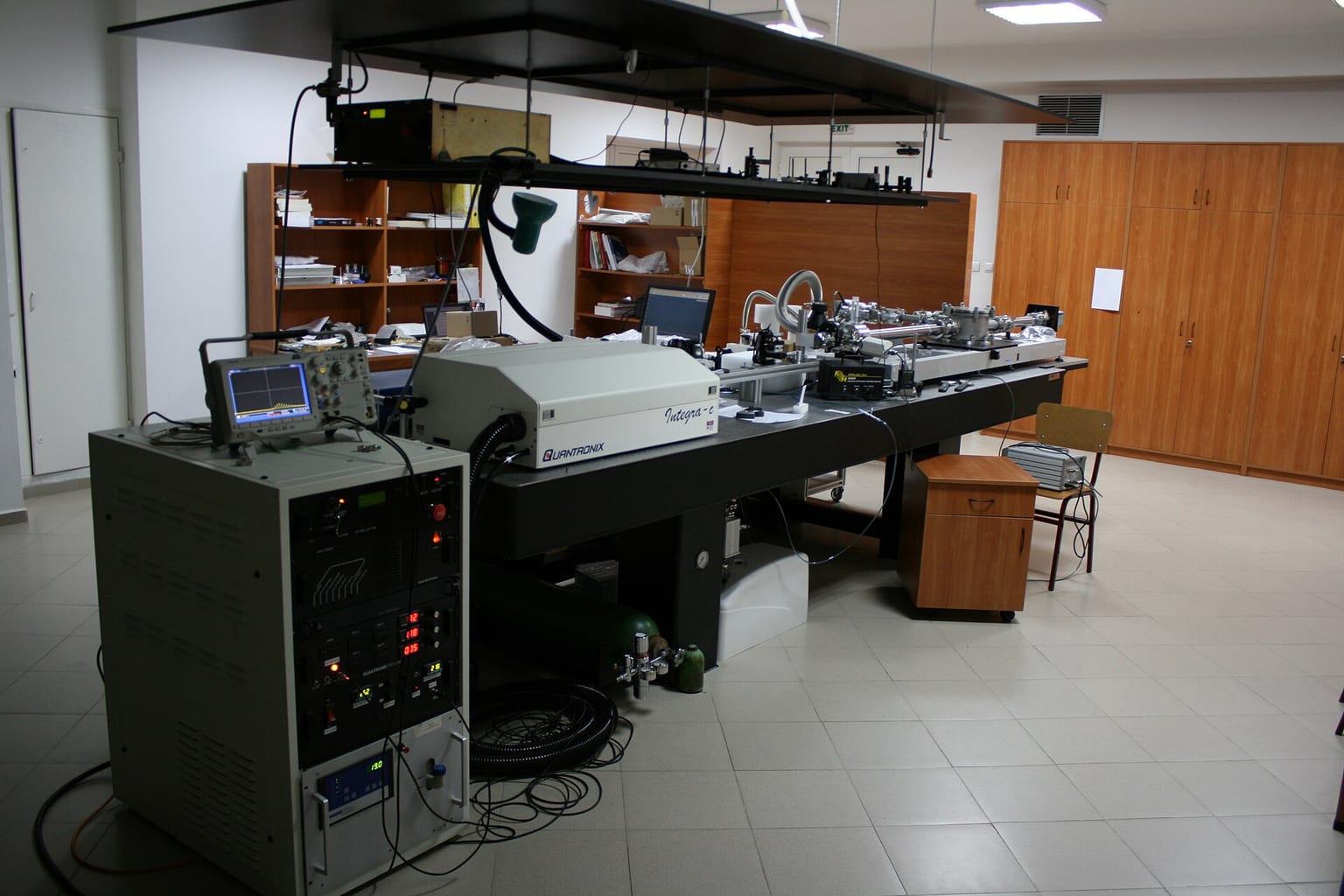
Two laser beams cross at a small angle inside a glass cell full of warm rubidium vapor. Where they overlap they write an interference pattern of alternating bright and dark bands, and the vapor follows that pattern: its refractive index, the number that sets how slowly light travels through it, changes from place to place. The lattice is made of light, and the laser light itself creates it. A team from the Quantum Technologies Group at the Institute of Physics Zagreb, with a colleague from the Physics Department at the Faculty of Science, reports in Laser & Photonics Reviews that this lattice can hold a beam of light still in shape. For the first time, the authors say, discrete one-dimensional solitons have been observed experimentally in such a structure.
The mechanism is a tug-of-war. A weak probe beam, focused on one lattice site, spreads to neighboring sites, which the team calls discrete diffraction: the periodic structure changes how light propagates compared with a uniform medium. Raise the probe power and the rubidium atoms respond nonlinearly, so the beam begins to self-focus. At approximately 6 mW the focusing counterbalances the spreading, and the beam settles into a soliton, a localized spot whose transverse profile remains nearly unchanged over the 50 mm length of the cell. The team recorded the profile at the cell exit for powers from 0.5 mW to 6.0 mW, and the change from spreading to a stable spot shows up clearly across that range.
The atoms are driven by two laser fields in a configuration known as the Λ-scheme, which uses three atomic energy levels. The authors also invoke electromagnetically induced transparency, under conditions of large detuning from single-photon resonance. Their model combines the paraxial wave equation, which describes how a laser beam propagates, with optical Bloch equations, which describe the atoms, and it includes the full hyperfine structure of the rubidium atom. The team reports good agreement between its experimental and numerical results. Earlier lattices were built in solid materials whose properties were fixed. Here the lattice can be retuned by changing the frequencies and intensities of the coupling beams, and the vapor allows coherent control of optical gain and loss.
For researchers in nonlinear optics and quantum fluids of light, the setup is a bench they can reshape with a few knobs rather than a crystal they must replace, which is why the authors list non-Hermitian dynamics, parity-time symmetry and dissipative solitons among the topics it opens. The team also names quantum memories, atomic clocks and chip-scale devices as areas where the approach may matter in the longer term. It gives no timeline for any of them, and no device built on this principle exists yet. What the paper establishes is a laboratory demonstration in one dimension, in a single vapor cell, with the measured profiles matched by the team's own model.
Sources — read the originals(Paris time)
Read next
Comments
Loading the thread…
Sign in to leave a comment. Sign in