In the lab, stacked Mylar insulates and survives heavy compression
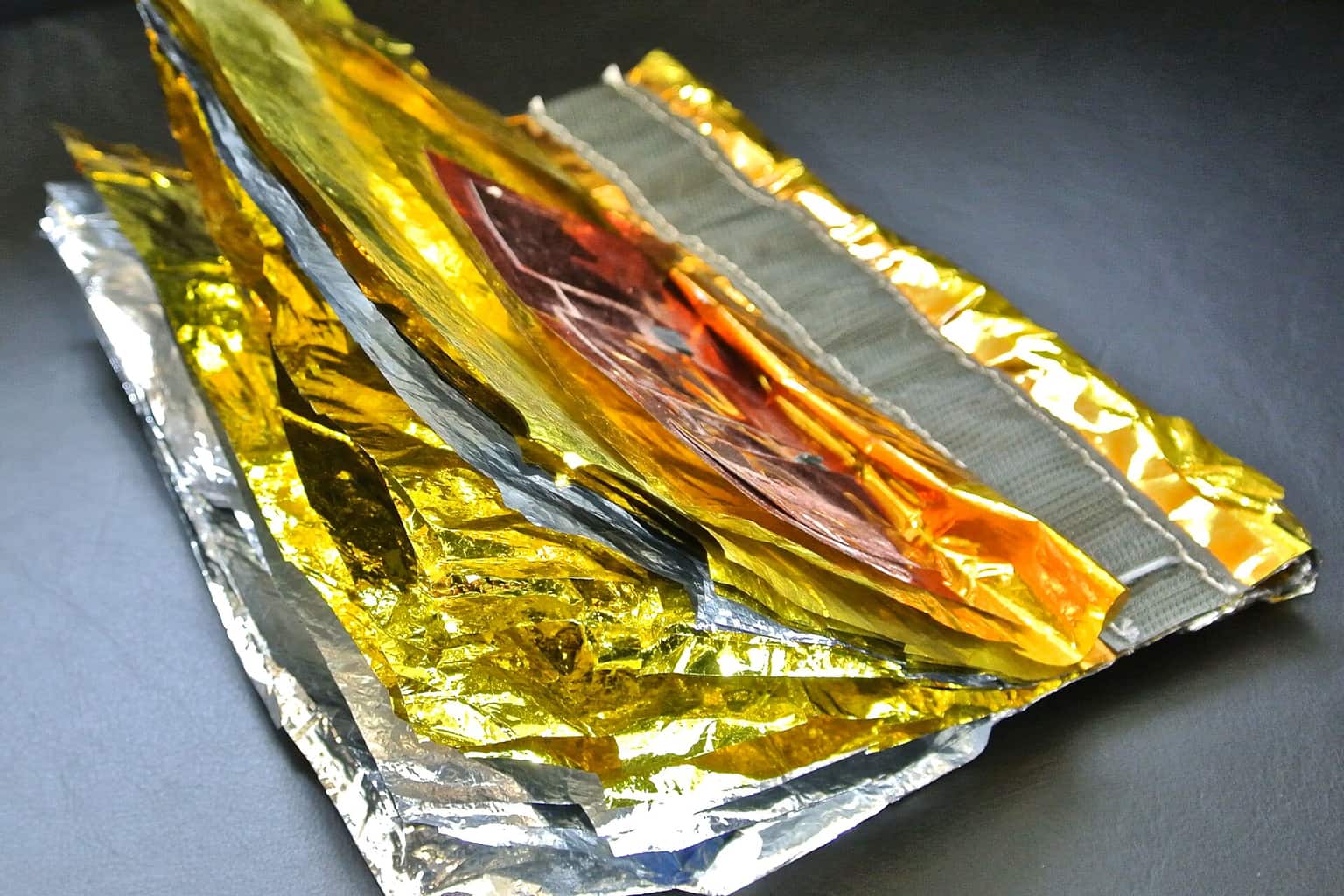
On the Moon, temperatures can swing from hundreds of degrees below zero to boiling, and any habitat will need insulation that holds up. At the University of Pennsylvania, engineers have found a surprisingly simple candidate: hundreds of sheets of Mylar, the plastic used as household food wrap and, once coated with aluminum, in the shiny blankets handed out after marathons. Stacked, the films insulate and stay tough.
The difficulty is that the best insulators tend to be the most fragile. Aerogels, which are made largely of empty space, protect industrial pipelines and NASA's Mars rovers, but can be damaged mechanically. Multilayer insulation, used in space, blocks radiant heat well, yet it is not designed to bear loads and tears easily when touched. Making an insulator stronger has usually cost it some thermal performance.
The team, led by senior author Igor Bargatin, an associate professor in mechanical engineering and applied mechanics, coats Mylar, known formally as BoPET (biaxially oriented polyethylene terephthalate), with an extremely thin layer of aluminum oxide, or alumina, to stiffen it. The films are then stacked one sheet at a time. The paper, published in ACS Applied Materials & Interfaces, calls the result hybrid layered insulating film stacks, or HyLIFS. In a vacuum, compressed as it would likely be in a habitat holding air at atmospheric pressure, the best stacks reached thermal conductivity comparable to other high-performance vacuum insulation while remaining flexible. In separate mechanical tests, the coated stacks kept that performance under the highest compressive stresses the lab's equipment could apply.
First author Danielle R. Levin, a recent Penn doctoral graduate in chemistry, said the team was unsure the films would hold up. The stacks were compressed repeatedly to approximately 20 megapascals, roughly the force of 200 pounds (91 kilograms) on a fingertip. “The stacks didn't survive just one high-stress cycle—they survived 10 in a row,” Levin said. The assembly itself is still slow: she described using two pairs of tweezers and small weights, and noted that even breathing near a stack can send the layers flying.
What changes is the handling. Anything built on the Moon has to be launched first, so a material that can be packed, transported and reused matters as much as its insulating power. Bargatin expects astronauts to bump into the walls, and the stacks were built to survive that. For lunar habitats, spacesuits and other equipment that must work in vacuum for years, the team says the material could open a pathway to inexpensive, durable and reusable insulation. Whether it gets there depends on moving a process that is still done by hand to mass production, and the team has not announced a timeline or cost for that step.
Sources — read the originals(Paris time)
Read next
Comments
Loading the thread…
Sign in to leave a comment. Sign in