In theory, light can pinpoint anyons for quantum computing
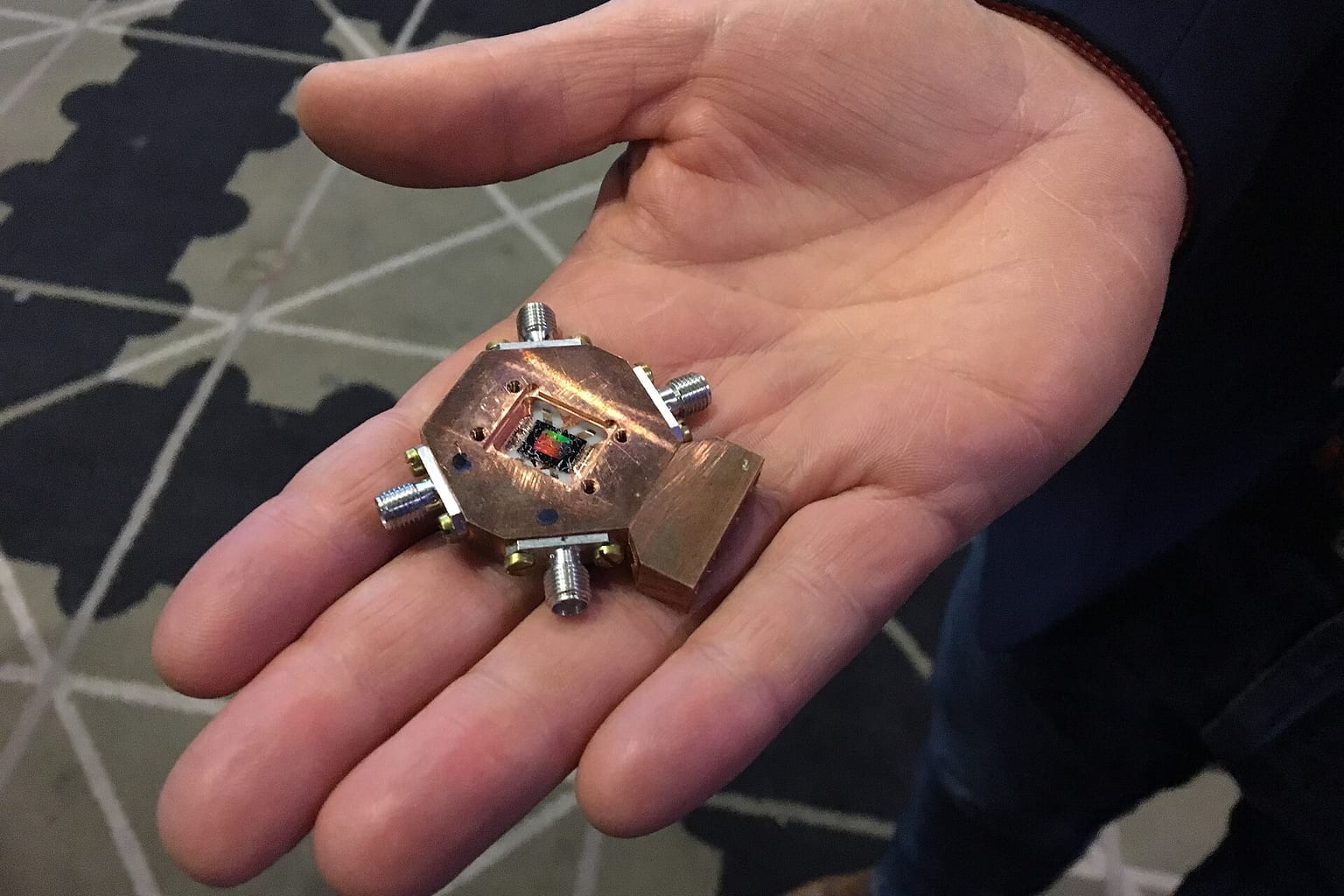
For nearly 100 years, physicists believed every electric charge came in whole multiples of a single unit: a proton carries a full positive charge, an electron a full negative one. In the 1980s, researchers showed that in two-dimensional systems, electron charges can split into fractions carried by quasiparticles that break those rules. They were named anyons for their 'anything goes' behavior. At Emory University, physicists Luiz Santos and his doctoral student Tianhong Lu have now found a way to see where one of them sits.
The trick is light. In certain atomically thin semiconductors, an electron can pair with a hole, a missing electron, to form an exciton, a neutral particle that interacts strongly with light. The team predicts that when an exciton drifts close enough to an anyon, the two bind into a new composite object, an exciton-anyon state. That binding should produce a detectable shift in energy, a 'spectral fingerprint' that reveals the anyon's position.
Anyons are not isolated particles. They emerge as collective ripples of electrons moving together, which makes them hard to observe. Physicists have already produced the effect in the lab, in a two-dimensional electron gas cooled to an ultralow temperature and placed in a strong magnetic field. Around three years ago, researchers reported producing it under less extreme conditions. Pinpointing the anyons, however, remained open.
For quantum computing, the stakes are concrete. Anyons could serve as qubits, the bits of quantum information, and Santos says they 'can hide themselves and avoid being perturbed by many environmental disturbances', which would make them more stable than typical quantum materials. Topological quantum computation, built on that property, remains theoretical. For experimentalists, the paper offers a predicted signal to look for. For the field, it offers a tool that could make anyons easier to study, though the method has not yet been tested in a real material.
The next step belongs to experimentalists. The team hopes they will build on the model and confirm the predicted energy shift in a physical system, moving topological quantum computing 'yet another step closer to reality'.
Sources — read the originals(Paris time)
Read next
Comments
Loading the thread…
Sign in to leave a comment. Sign in