Lab-tested perovskite cells keep 95% of initial efficiency after 1,000 hours
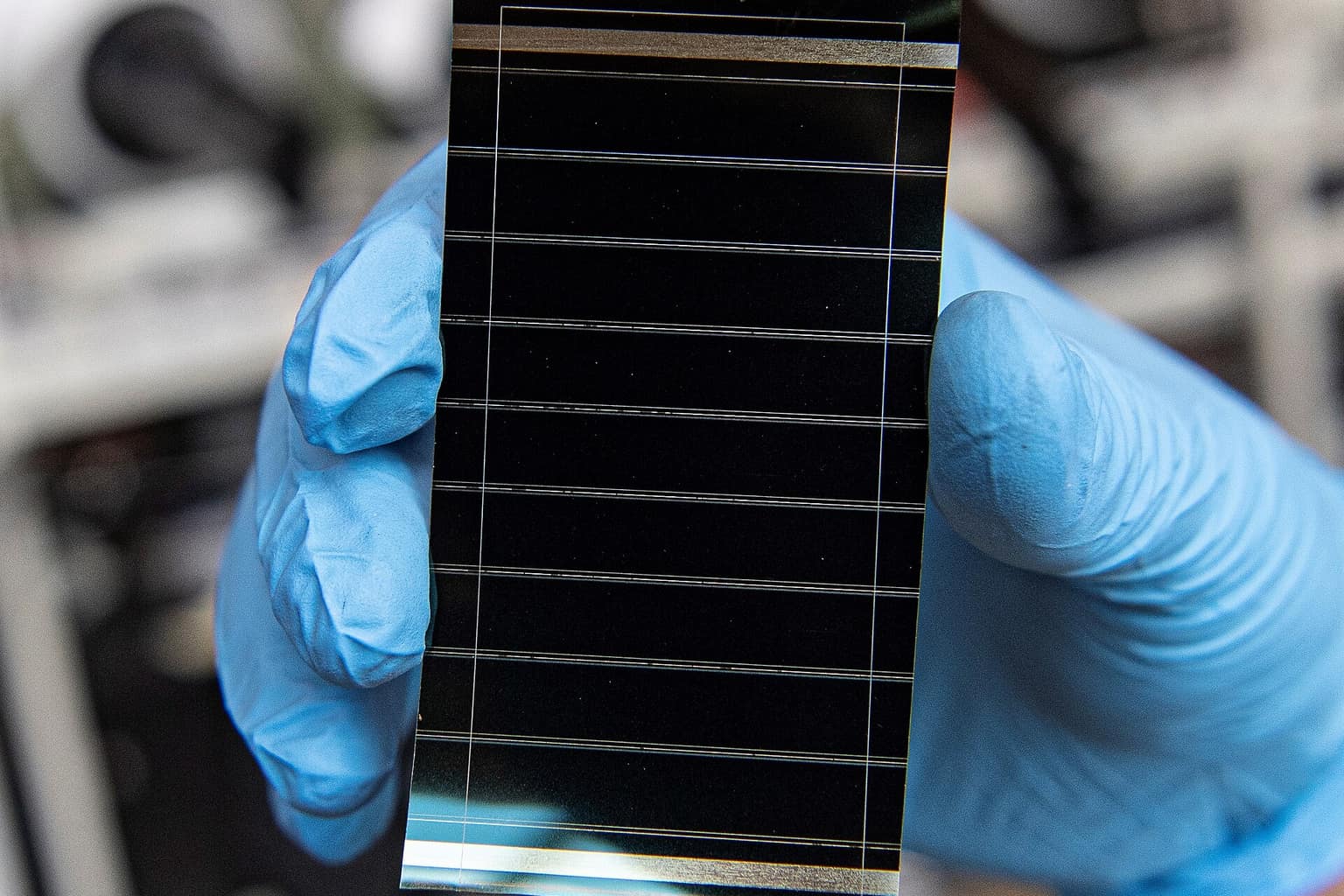
The test cells sat for 1,000 hours at 85 degrees Celsius and 85% relative humidity, a combination that can accelerate perovskite degradation. When the team checked them at the end, they still delivered 95% of their starting power conversion efficiency. The result comes from the Korea Institute of Energy Research (KIER) in Daejeon, where SeJin Ahn leads the work, with a group led by Dong-Seok Kim at the Ulsan National Institute of Science and Technology (UNIST).
Perovskite cells have drawn attention for their high conversion efficiency and their low manufacturing cost, and they are light enough for flexible panels. Their weak point is lifespan: they last between two and 10 years, compared with 25 to 30 years for silicon panels. Heat and moisture accelerate their decay, which hurts their reliability in hot and humid climates.
The culprit is the hole transport layer, the thin film that carries charge inside the cell. Lithium salts and additives there improve efficiency, but in hot and humid conditions the additives can evaporate and leave tiny gaps that reduce performance. Lithium ions also move freely and cause further damage. Until now, researchers had struggled to remove these substances without losing the cell's ability to convert sunlight.
The KIER method sidesteps that trade-off. Nickel oxide powder is added to the solution, and its surface changes so that it attracts lithium ions and separates them from the salt, without any chemical additive. The powder particles are relatively large, so a physical filter traps them along with the lithium. The filtered solution is free of additives, residual lithium and catalyst, and it can form a defect-free layer. The new cells reached 25.24% efficiency, slightly above the 25.21% of conventional cells, and the team says this could help tandem solar cells, which stack two absorbing layers.
The reported gain is durability while performance is preserved. According to the team, the process could help perovskite cells compete with traditional silicon panels, and Ahn describes solving the lifetime problem as a milestone toward commercialization. The tests were run in the laboratory, and the team has not announced a date for commercial production or a field trial.
Sources — read the originals(Paris time)
Read next
Comments
Loading the thread…
Sign in to leave a comment. Sign in