Lab: salt keeps perovskite solar cells at 85.8% after 1,400 hours
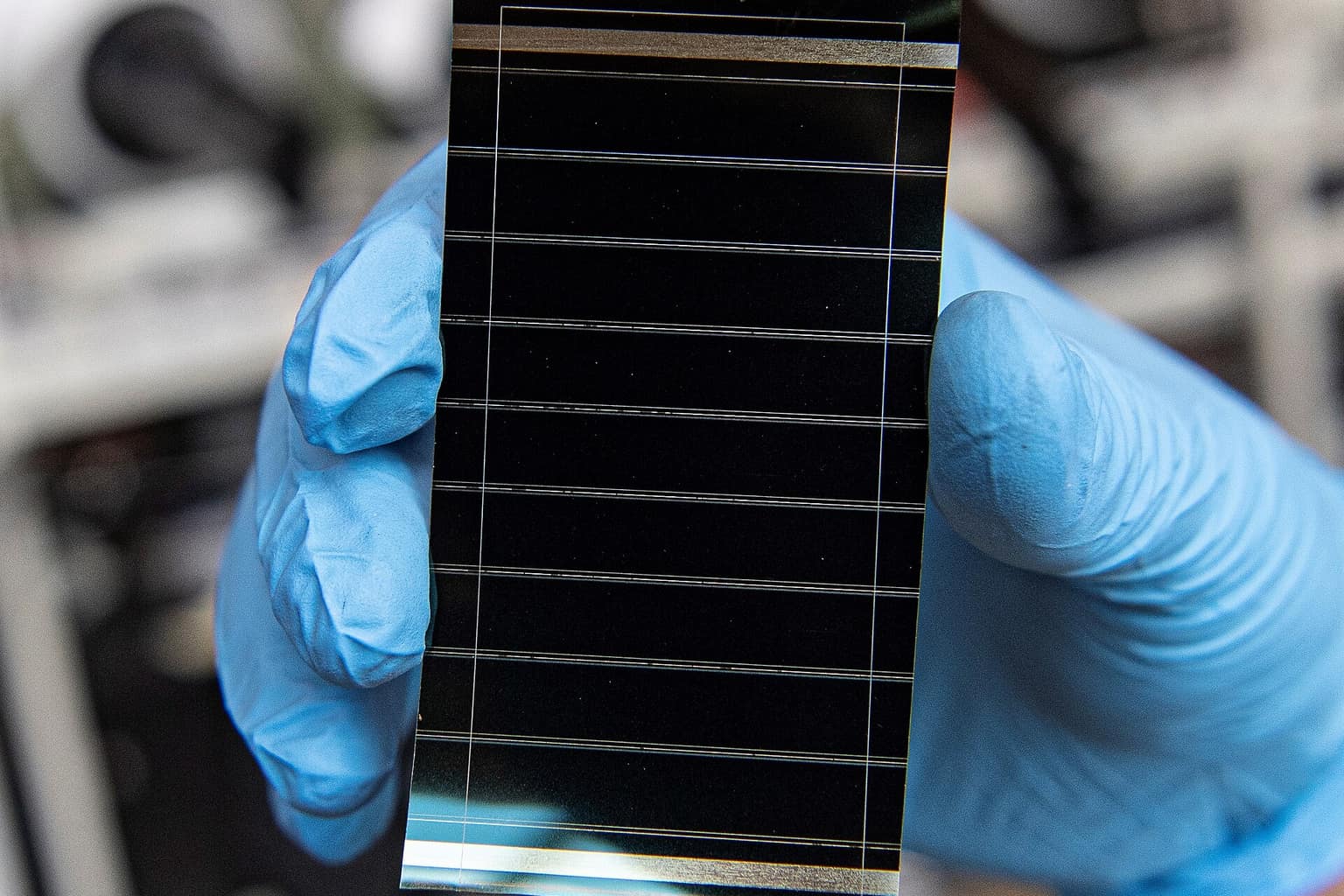
On an icy road, a handful of salt melts the thin film of ice and gives tires their grip back. At the U.S. Department of Energy’s Argonne National Laboratory, scientists are applying that same basic principle to perovskite crystals, the material used in some solar panels, screens and camera sensors. Their new process, built on salt additives, produces crystal layers with fewer defects and much more stable performance.
Perovskites are synthetic crystals made of repeating atomic patterns. They absorb light and move electric charges, but as the films settle, tiny atomic defects form like potholes. They trap charges, drain energy and shorten the life of the device. The team used a eutectic method, a mixture that melts at a lower temperature than its ingredients do. Two additives, zinc bromide and methylammonium chloride, lower the melting point of the perovskite ingredients, as road salt lowers the freezing point of water. When heated, the mixture briefly turns into a liquid slush, and that brief liquid state gives the atoms time to settle into a uniform grid instead of freezing into a scrambled pattern. Then the added salts evaporate entirely, leaving a pure crystal layer, while leftover zinc atoms drift toward remaining fault lines and smooth them out before they can ruin performance.
Small solar cells built with the volatile eutectic method reached a certified power conversion efficiency of 25.9%, and larger perovskite minimodules reached 23.9%. Small-area cells kept 85.8% of their initial efficiency after 1,400 hours of continuous operation at 85°C (185°F). The process also powered light-emitting diodes to 26.1% external quantum efficiency. “Defects have been the bottleneck for perovskites for almost a decade,” said study author Yanqi Luo, a beamline scientist in Argonne’s X-ray Science division. “If we can remove the major defects, we can finally start building devices that last longer and perform more reliably.”
The team did not only measure the result; it watched the process. Using high-intensity X-ray probes at Argonne’s Advanced Photon Source and Center for Nanoscale Materials, the researchers mapped composition and optical performance at the same moment, and saw zinc atoms move to repair fault lines in real time. For makers of solar cells, screens and camera sensors, the gain would be crystals that keep their performance over time and can be grown over large areas, since the mechanism produces smooth, consistent growth. Those are the conditions that manufacturing needs, and the report presents the method as a step forward for production.
The figures remain lab figures. The highest efficiencies come from small certified cells, the larger minimodules reach a lower 23.9%, and the durability test is an accelerated run at 85°C rather than years of use. The study gives no date for commercial products. The next step is already defined: the Advanced Photon Source has recently been upgraded to produce X-ray beams up to 500 times brighter, and the scientists plan to move from snapshot analysis to continuous, movie-like views of crystal growth.
Sources — read the originals(Paris time)
Read next
Comments
Loading the thread…
Sign in to leave a comment. Sign in