Milky Way simulated star by star, thanks to an AI shortcut
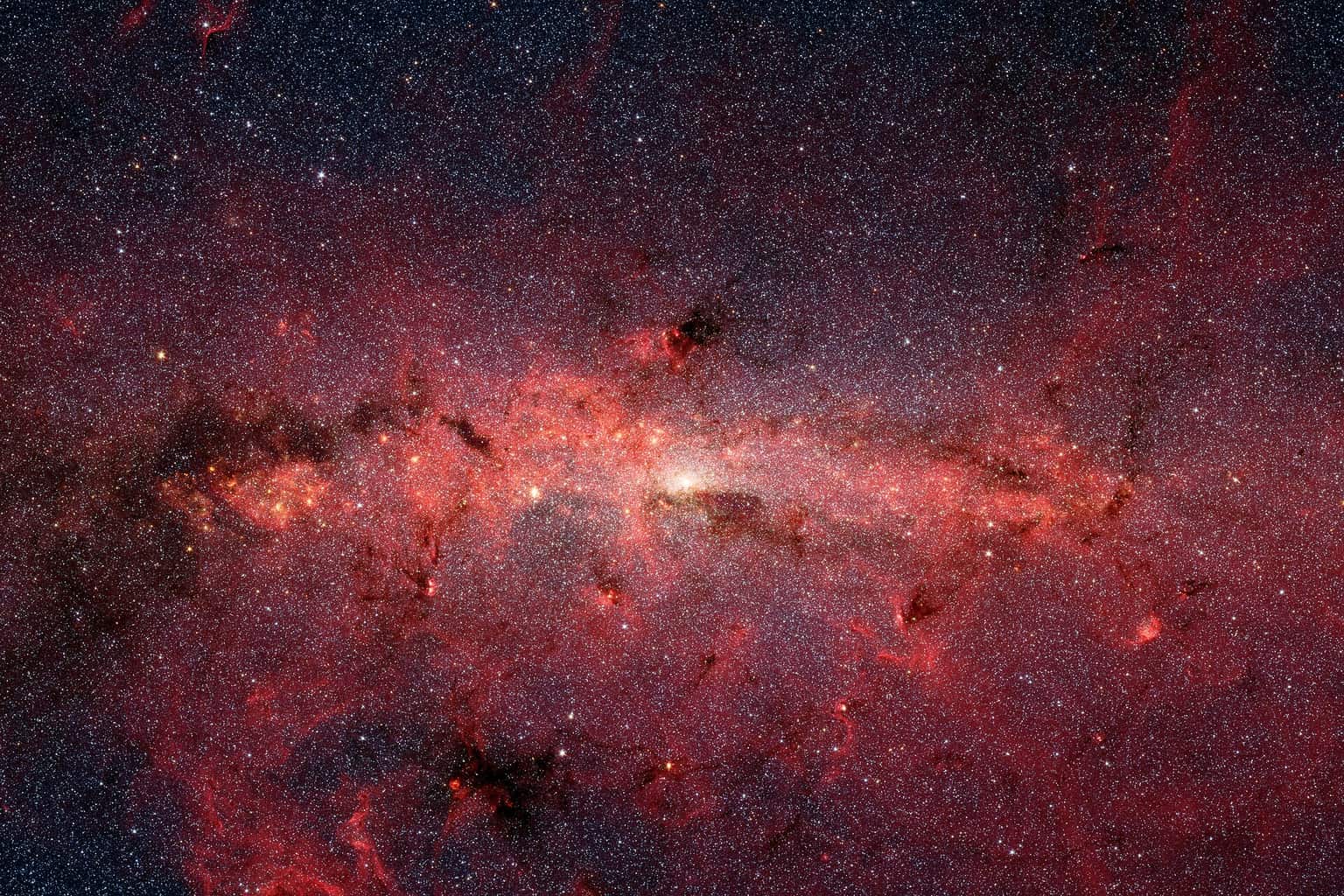
A simulation of the Milky Way can now follow its individual stars on three supercomputers working together. A team that includes researchers from the University of Tokyo built it and presented the work at SC 2026, the international high-performance computing conference, held November 15 to 20 in Chicago. The key trick is an AI model that takes over the calculation of gas around supernovae, the step that forces the smallest time steps.
Galaxy simulations have always had to cut corners. The most detailed ones could handle a mass limit of about one billion suns, while the Milky Way holds more than 100 billion stars. The obstacle is time. When a star explodes as a supernova, the gas around it heats up and rushes outward, and a computer has to advance in very small steps to follow that motion. In a galaxy as large as ours, these pockets of fast change force the whole simulation to slow down.
Keiya Hirashima, a postdoctoral researcher at RIKEN, trained an AI model on high-resolution simulations of a single supernova. Calculated directly, the gas around the blast requires time steps of about 100 years. His model predicts how that gas spreads over the following 100,000 years, so the main simulation can take one much longer step and skip the many small calculations in between. The team says the result is around 20 times faster than calculating the same process the usual exhaustive way.
Running the code was a problem of its own. The simulation was spread across three different supercomputers, each built with different processing chips, the CPUs and GPUs that do the calculating, made by AMD, Intel or NVIDIA. “Making this work efficiently on different supercomputers was a challenge,” Hirashima said, and reaching good performance on all three required specific optimizations. The team's latest work was to adapt the software so it runs well on that mix of hardware.
Why go down to single stars? Massive stars are born in groups, often in the spiral arms where cold gas gathers. Their heat and their explosions can blow enormous bubbles of hot gas, which can trigger new star formation and push material out of the galaxy's disk. A simulation that averages these events away can paint a different picture of how gas is distributed and how the galaxy evolves. “With this simulation, we can investigate how individual supernovae affect the number of stars that form, the size of these giant gas bubbles and the material that flows out of the galaxy,” said Michiko Fujii, professor in the Department of Astronomy at the University of Tokyo.
The team reports that the star formation rate in its simulation agrees with observational estimates for the Milky Way. The limits are just as clear. The speed-up applies to the supernova calculation, not to the whole run, and the authors note that they have not yet simulated the full process through which a galaxy like ours forms.
For astronomers, the payoff is a way to follow the chain from single stars to the whole galaxy, on a computer. Stars forge the elements that make up our bodies and release them through explosions, and the simulation lets researchers trace how those elements spread through the galaxy over time, and how small-scale stellar activity shapes its larger structure.
The next questions the team lists are concrete: how individual supernovae change the number of stars that form, how large the gas bubbles grow, and how much material leaves the galaxy.
Sources — read the originals(Paris time)
Pages consulted while writing
Read next
Comments
Loading the thread…
Sign in to leave a comment. Sign in