Three new faint objects spotted in Cassiopeia after 100 hours
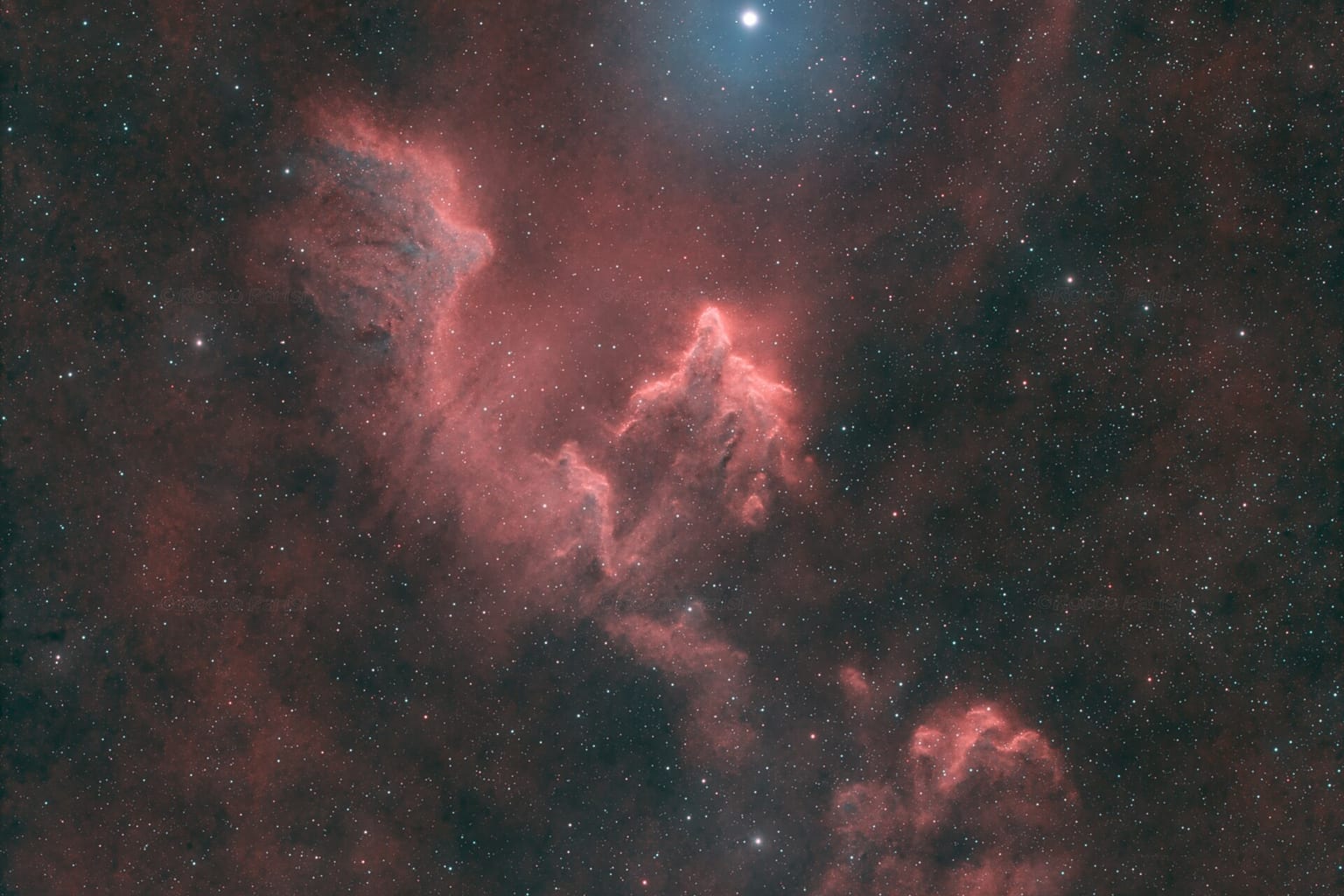
Blue phantoms took 100 hours of observation to show up over Cassiopeia. The image, credited to Louis Leroux-Géré, Thibault Rouillée, Vincent Martin and Cédric de Decker of Starfront Observatories, needed a special oxygen filter to pick them out of the dark. Two of the ghosts are already known: IC 59 and IC 63, the original Ghosts of Cassiopeia, which sit near the multi-star system γ Cassiopeia. The newcomers are three objects, numbered 1, 2 and 3, all newly discovered.
The two old ghosts appear mostly red. Energetic light from γ Cassiopeia makes their hydrogen gas glow red, while their dust scatters some blue-white starlight. The new objects look different: they glow blue, which reveals the presence of ionized oxygen, oxygen atoms that have lost electrons. Something has to supply the energy that strips those electrons, and the page does not say what that is. That energy source is the unresolved part of the picture.
The explanation offered comes from a boat. A speeding boat pushes a wave at its bow, and γ Cassiopeia, moving through interstellar gas and dust, may be piling up material in the same way. If so, Object 3 would be oxygen compressed and heated at that bow shock. The page presents this as a possibility, not a measurement.
Object 1 is treated with the same caution. It could be a planetary nebula, a shell of gas cast off by a dying star, if a central white dwarf, the dense remnant of such a star, is identified. The page's own words are that the origins of these objects "remain a mystery to be solved." No date is given for checking either interpretation, and no follow-up observation is announced.
For astronomers, the gain is a shortlist: three candidates and two clear questions to answer, whether Object 1 hides a white dwarf and whether Object 3 sits in a bow shock. For everyone else, the lesson is about patience. A faint blue glow that the eye would miss became a result after 100 hours of watching and one filter, which shows how far long observation can reach into a dim corner of the sky. The timeline stays open: nothing in the image says when the three objects will be settled.
Comments
Loading the thread…
Sign in to leave a comment. Sign in