Sand grain size reveals how fast the wind blew, on Earth and Mars
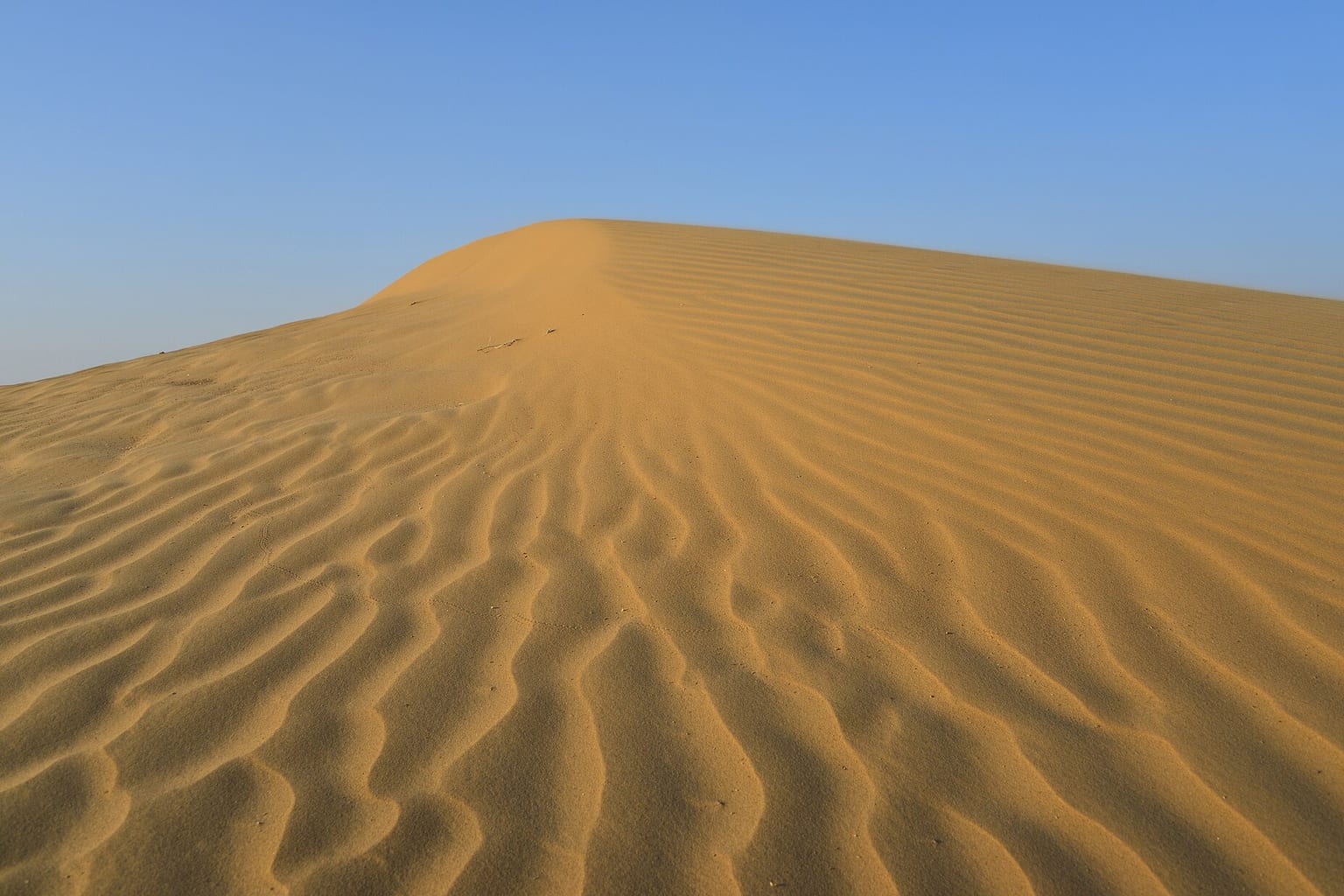
Some of the dunes in Namibia's Namib Sand Sea rise a hundred meters above the desert floor, in ridges spaced about two kilometers apart. Their shape has long told scientists which way the wind blew. How fast it blew has been much harder to read. A team at Stanford University now says the answer is in the sand: the typical size of the grains in a dune records the speed of the wind that built it, on Earth and on Mars.
The principle is simpler than it sounds. Wind moves sand only once it passes a threshold, the speed at which grains begin to travel along the ground. In a study published on November 16 in the Proceedings of the National Academy of Sciences, the Stanford researchers found that dunes on both planets are built by winds that only just exceed that threshold, and that the wind speed doing most of the work is determined largely by grain size. Measure the median grain size, and you can estimate the wind that formed the dune.
The idea itself is not new. In 2010, researchers at the University of Pennsylvania proposed that windblown dunes form through winds slightly faster than the threshold for moving sand. "Since then, nobody's really looked at this idea," said lead author Colin Marvin, who carried out the work as a PhD student in the lab of Mathieu Lapôtre, associate professor at Stanford's Doerr School of Sustainability. To test it, the team analyzed 30 years of wind data and grain-size measurements from 24 dune fields of different shapes, sizes and locations. For each one, they calculated which wind speed moved the most sand over time. The link to grain size held at every field, from Coral Pink Sand Dunes State Park in Utah to the dunes of Namibia, and the winds only modestly exceeded the threshold.
The team then ran the same analysis on a dune field on Mars. Mars has very different atmospheric pressure, gravity and sediment density from Earth, yet a similar correlation appeared. The authors read this as a sign that windblown dunes form in essentially the same way wherever there is loose sediment and winds that become rarer as they strengthen, and that dunes formed similarly in Earth's deep past. That conclusion rests on a single Martian field, a limit the team's own data cannot yet lift.
For scientists, the method turns ancient rock into a wind record. Lapôtre says it works for modern dunes and for sandstones dating back 3 billion years, which should let researchers "better reconstruct winds and climates through time, on Earth and beyond." Those reconstructions could in turn test models of ancient atmospheric circulation on Earth and Mars. Marvin is already working on that next step, Lapôtre said, and no timetable for it has been given.
Sources — read the originals(Paris time)
Pages consulted while writing
Read next
Comments
Loading the thread…
Sign in to leave a comment. Sign in