Superinductor fabricated in standard silicon chips
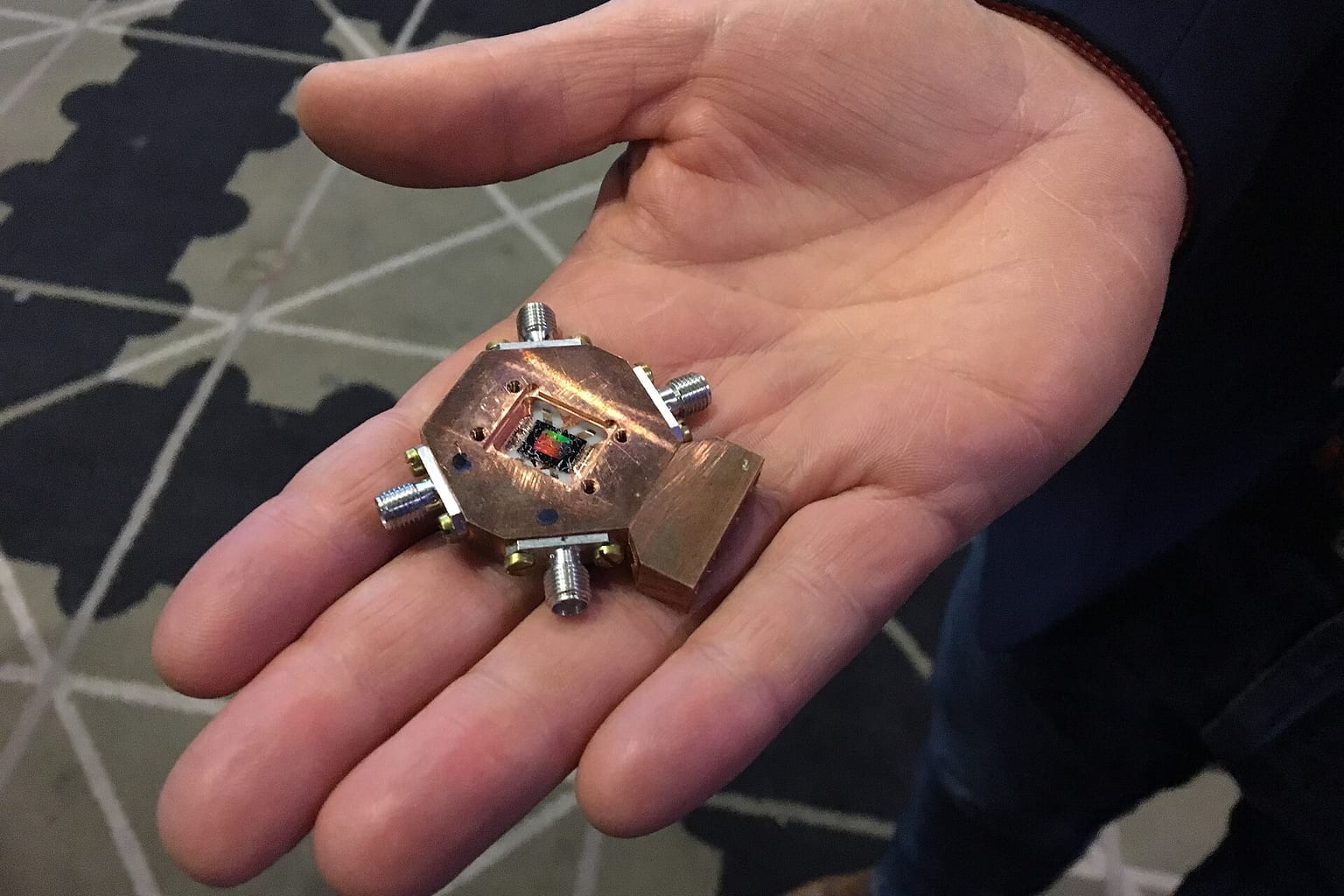
A silicon quantum chip, held in tweezers, looks like any small electronic part. Its most unusual feature is not visible: a superinductor, a component whose inductance is far larger than what a conventional coil can reach. A team from Quantum Motion, Imperial College London, the University of Cambridge and nanoGUNE's Quantum Hardware group has now built one inside a silicon integrated circuit, fabricated in a commercial CMOS process, the complementary metal-oxide-semiconductor method used to make standard chips.
Superinductors matter for superconducting qubits and quantum circuits. A large inductance can dramatically alter a circuit's quantum behaviour, and it allows circuits with very large impedance and very small inductive energy scales. The team used titanium nitride (TiN), a material whose high kinetic inductance makes it possible to create compact, high-inductance elements while keeping robust superconducting properties.
The device is a nonlinear superinductor. It can be used to create a radiofrequency single-electron transistor, a widely used sensor for semiconductor spin qubits, with a compact footprint and high sensitivity. The next step is to integrate the resonator with multi-gate transistors to demonstrate high-speed, high-fidelity spin readout well below the microsecond timescale. That demonstration has not yet been carried out, and the study reports a development rather than a measured readout speed.
According to the team, the applications of TiN-based CMOS inductors “could expand well beyond quantum sensing and computing for spin qubits”, with possible impacts in radio astronomy, low-power cryoelectronics and quantum simulations. These are directions the researchers name, not uses already in operation.
For groups building silicon spin qubits, the change is practical: the sensing element could be made with the same manufacturing methods as the rest of the circuit. The researchers do not give a date for the integrated readout, and no price or industrial partner is announced. What comes next is the test on multi-gate transistors.
Sources — read the originals(Paris time)
Read next
Comments
Loading the thread…
Sign in to leave a comment. Sign in